Escápula alada: dois padrões de winging e por que se confundem
Em 30 segundos
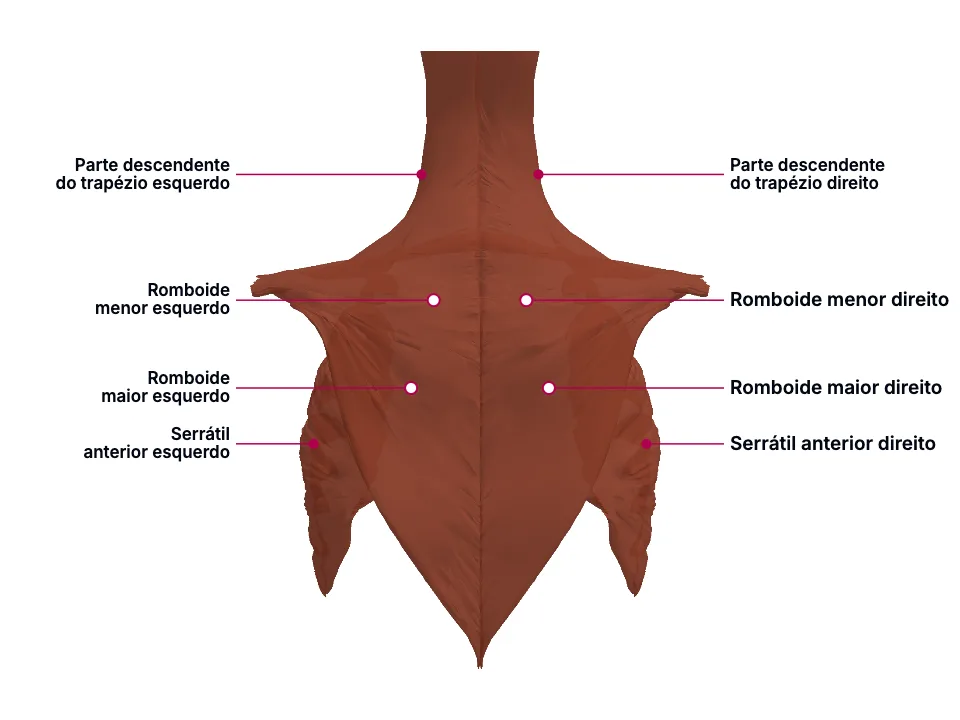
A escápula fica presa à parede torácica pelo equilíbrio de três músculos que puxam em direções diferentes - serrátil anterior (protrai), trapézio (eleva/retrai/deprime) e romboides (retraem e fixam a borda medial) - e perder qualquer um deles rompe esse equilíbrio, produzindo escápula alada ('winging').
Escopo e método deste resumo
A escápula fica presa à parede torácica pelo equilíbrio de três músculos que puxam em direções diferentes - serrátil anterior (protrai), trapézio (eleva/retrai/deprime) e romboides (retraem e fixam a borda medial) - e perder qualquer um deles rompe esse equilíbrio, produzindo escápula alada ('winging'). O padrão MEDIAL (escápula translada para cima, ângulo inferior gira em direção à coluna) vem da paralisia do serrátil anterior por lesão do nervo torácico longo, cujo trajeto longo e superficial na parede lateral do tórax o expõe tanto à dissecção axilar/mastectomia quanto a esportes de arremesso - é a causa mais comum de todas. O padrão LATERAL (escápula translada para baixo, ângulo inferior gira para longe da coluna) vem classicamente da paralisia do trapézio por lesão do nervo acessório espinhal no triângulo posterior do pescoço (biópsia de linfonodo cervical é a causa iatrogênica clássica), mas também pode vir dos romboides (nervo dorsal da escápula, raiz C5 isolada) - uma causa mais rara e um achado tipicamente sutil, subdiagnosticado pela posição profunda do músculo.
Material educacional escrito com apoio de IA e conferido por revisão automatizada, sem revisão médica nomeada. Não substitui o livro-texto nem orientação clínica.
Essencial
O serrátil anterior se origina nas primeiras costelas e se insere na escápula: 'The serratus anterior is a fan-shaped muscle that originates on the superolateral surfaces of the first to eighth ribs or the first to ninth ribs at the lateral wall of the thorax and inserts along the superior angle, medial border, and inferior angle of the scapula.' Sua ação é puxar a escápula para frente ao redor do tórax: 'The serratus anterior muscle pulls the scapula forward around the thorax, which allows for anteversion and protraction of the arm'
Quem inerva esse músculo é o nervo torácico longo, formado pelas raízes C5 a C7: 'The long thoracic nerve, which originates from the upper portion of the superior trunk of the brachial plexus and is typically composed of cervical nerves C5, C6, and C7, is responsible for the innervation of the serratus anterior.' Esse nervo corre de forma longa e superficial sobre a própria superfície do músculo que inerva: 'The long thoracic nerve courses inferiorly on the surface of the serratus anterior and, as such, is susceptible to damage during specific surgical procedures, especially with axillary lymph node dissection.' e 'The long thoracic nerve is at risk of compression due to its superficial course along the lateral chest wall.' - uma exposição que o torna vulnerável tanto a procedimentos cirúrgicos quanto a esportes: 'Thoracic procedures, such as radical mastectomy, transthoracic sympathectomy, misplaced intercostal drains, axillary lymph node dissections, and resection of the first rib, increase the exposure of the long thoracic nerve and risk of nerve injury.' e 'The sports involved in serratus anterior paralysis include archery, baseball, basketball, bodybuilding, bowling, football, golf, gymnastics, hockey, soccer, tennis, and wrestling.'
O trapézio tem três porções funcionais distintas. A superior eleva e roda a escápula para cima: 'The upper fibers can elevate and upwardly rotate the scapula and extend the neck.' A média aduz as duas escápulas: 'The middle portion attaches to the upper part of the spinous processes of C7-T12. This portion adducts (draws together) the 2 scapulae.' E a inferior deprime a escápula e ajuda a rotação para cima: 'The lower fibers depress and assist the upper fibers in the upward rotation of the scapula.'
A função motora das três porções depende de um único nervo: 'The ventral rami of C3 and C4 innervate the sensory functions of the trapezius. The spinal accessory nerve (cranial nerve XI) innervates the motor function of the trapezius.' Esse nervo atravessa uma região superficial e estreita do pescoço antes de alcançar o músculo: 'The spinal accessory nerve then passes through the posterior triangle of the neck.' - 'The 3 sides of the triangle are formed by the sternocleidomastoid, trapezius, and clavicle. The nerve then passes beneath the trapezius, where it innervates it.' Uma lesão que ocorra justamente dentro dessa região tem uma consequência precisa: 'Only the trapezius is denervated if the nerve is injured within the posterior triangle.' É exatamente esse cenário que torna certos procedimentos cirúrgicos a causa iatrogênica mais comum de paralisia do trapézio: 'Iatrogenic injury to the spinal accessory nerve during cervical lymph node biopsy or excision is the most common cause of trapezius palsy.'
Os romboides são dois músculos - maior e menor - com origem e inserção próprias. O menor: 'The rhomboid minor is a cylindrical muscle that originates at the ligamentum nuchae and C7 and T1 vertebra. It inserts at the scapula's medial border near the base of the spine of the scapula.' O maior: 'The rhomboid major is a quadrangular muscle located inferior to the rhomboid minor. The origin of the rhomboid muscles is from the spinous processes of the T2-T5 vertebra and inserts on the medial border of the scapula, just inferior to the rhomboid minor.' Juntos, sua ação é: 'Functionally, the rhomboid muscles retract, elevate and rotate the scapula. They also protract the medial border of the scapula, keeping it in position at the posterior thoracic wall.'
A inervação motora dos dois vem de um único nervo: 'The motor function of the rhomboid muscles is controlled by the dorsal scapular nerve (DSN). The dorsal scapular nerve originates from the ventral ramus of the spinal nerve root C5 and courses posterior inferiorly through the middle scalene muscles and between the posterior scalene, levator scapulae (to which it also provides innervation), and the serratus posterior superior.' Esse nervo nasce isoladamente de UMA raiz cervical - sem passar pelos troncos do plexo braquial, como acontece com o nervo torácico longo (C5-C7) ou o acessório espinhal (que desce do crânio): 'The dorsal scapular nerve (DSN) is a motor nerve arising from the ventral ramus of the C5 nerve root. Once branching from the brachial plexus, the DSN pierces the middle scalene muscle, coursing deep to the levator scapulae and the rhomboid major and minor muscles.' e 'The dorsal scapular nerve is a motor nerve that innervates the levator scapulae, rhomboid major, and rhomboid minor muscles.'
Os três músculos - serrátil anterior, trapézio e romboides - cumprem a mesma função geral, cada um a seu modo: 'These muscles contribute to maintaining the scapula protracted against the posterior thoracic wall. Neurologic insult to any of these muscles results in winging of the scapula as it lifts off the thoracic wall.' É por isso que a maioria dos casos de escápula alada nasce de apenas dois deles: 'Most cases are secondary to neurologic lesions involving the serratus anterior and trapezius muscles. Scapular winging may be caused less frequently by neurologic lesions involving the rhomboid muscles.'
A aparência geral - a escápula se soltando da parede torácica - é a mesma nos dois padrões, mas a DIREÇÃO do deslocamento diferencia um do outro com precisão: 'Long thoracic nerve injury results in serratus anterior muscle paralysis and causes medial scapular winging. The scapula translates superiorly, and the inferior angle rotates medially. Spinal accessory nerve injury results in trapezius muscle paralysis and causes lateral scapular winging. The scapula translates inferiorly, and the inferior angle rotates laterally.' A explicação fisiológica para essa diferença de direção está no equilíbrio de forças entre os três músculos: 'A weakness of the serratus anterior muscle is the most prevalent cause of winging due to the weak protraction of the scapula and unopposed medial scapula retraction by the rhomboid muscles and elevation by the trapezius, resulting in medial winging of the scapula. This condition is easily differentiated from the much less common lateral winging due to weakness of the trapezius muscle, which is supplied by the spinal accessory nerve.' Resumindo a distinção entre os padrões: 'Medial scapular winging typically results from weakness of the serratus anterior muscle, often caused by injury to the long thoracic nerve. In contrast, lateral winging arises from dysfunction of the trapezius or rhomboid muscles, associated with spinal accessory or dorsal scapular nerve impairment.'
Na clínica
Quando o nervo torácico longo é lesado, o serrátil anterior não consegue mais segurar a escápula contra a caixa torácica: 'If the long thoracic nerve is damaged, a clinical phenomenon known as a winged scapula occurs as the serratus anterior is no longer able to hold the scapula against the chest wall. The winging is medial scapula winging that has to be differentiated from lateral winging due to a weakness of the rhomboids or the trapezius muscles.' Esse é, de fato, o padrão mais comum de todos: 'The most common cause of scapular winging is serratus anterior paralysis after an insult to the long thoracic nerve.'
A paralisia do trapézio por lesão do nervo acessório espinhal produz um padrão de winging bem definido: 'Lateral scapular winging results from a deficit in trapezius muscle function secondary to injury to the spinal accessory nerve.' - com uma direção específica de deslocamento: 'Long thoracic nerve injury results in serratus anterior muscle paralysis and causes medial scapular winging. The scapula translates superiorly, and the inferior angle rotates medially. Spinal accessory nerve injury results in trapezius muscle paralysis and causes lateral scapular winging. The scapula translates inferiorly, and the inferior angle rotates laterally.'
A paralisia dos romboides também entra na categoria de winging lateral, mas com uma frequência e uma clareza clínica bem diferentes das do trapézio: 'Lateral scapular winging can also result from a deficit in rhomboid muscle function secondary to injury to the dorsal scapular nerve. Rhomboid paralysis is less common than trapezius paralysis.' Epidemiologicamente, 'Rhomboid paralysis is also rare, and its associated functional impairments are even less common.' E quando o achado aparece, ele costuma ser difícil de reconhecer: 'Physical examination often yields subtle lateral winging of the scapula. As a result of the subtle exam finding and the deep anatomic position of the rhomboids, rhomboid palsy is often underdiagnosed.'
Como a inspeção visual sozinha pode ser ambígua, a diferenciação clínica usa testes de força que isolam cada músculo especificamente: 'Trapezius muscle strength can be tested with resisted elevation of the scapula. The function of the rhomboid and levator scapulae is evaluated by having the patient place both hands on the hips and pushing the elbows posteriorly against resistance. Serratus anterior strength can be assessed with the forward shoulder flexion to 90° while the patient performs push-ups.'
Abrir o aprofundamento
Aprofundamento
A escápula não fica presa à caixa torácica por encaixe ósseo - ela é mantida ali por músculos que a protraem contra a parede torácica posterior: 'These muscles contribute to maintaining the scapula protracted against the posterior thoracic wall. Neurologic insult to any of these muscles results in winging of the scapula as it lifts off the thoracic wall.' Qualquer um desses músculos, ao falhar, permite que a escápula se solte: 'Most cases are secondary to neurologic lesions involving the serratus anterior and trapezius muscles. Scapular winging may be caused less frequently by neurologic lesions involving the rhomboid muscles.'
Serrátil anterior - inervado pelo nervo torácico longo (C5-C7), de curso longo e superficial ao longo da parede lateral do tórax: 'The long thoracic nerve courses inferiorly on the surface of the serratus anterior and, as such, is susceptible to damage during specific surgical procedures, especially with axillary lymph node dissection.' Sua paralisia é a causa mais comum de escápula alada, com padrão MEDIAL: 'The most common cause of scapular winging is serratus anterior paralysis after an insult to the long thoracic nerve.'; Trapézio - inervado pelo nervo acessório espinhal (com contribuição de C3-C4 do plexo cervical), que atravessa o triângulo posterior do pescoço antes de alcançar o músculo, e cuja lesão ali denerva SÓ o trapézio: 'Only the trapezius is denervated if the nerve is injured within the posterior triangle.' A biópsia de linfonodo cervical nesse ponto é a causa iatrogênica mais comum de paralisia isolada do trapézio, com padrão LATERAL: 'Iatrogenic injury to the spinal accessory nerve during cervical lymph node biopsy or excision is the most common cause of trapezius palsy.'; Romboides (maior e menor) - inervados por um único nervo, o dorsal da escápula, que nasce isoladamente da raiz ventral de C5 e corre profundo, sob o levantador da escápula e os próprios romboides: 'The dorsal scapular nerve (DSN) is a motor nerve arising from the ventral ramus of the C5 nerve root. Once branching from the brachial plexus, the DSN pierces the middle scalene muscle, coursing deep to the levator scapulae and the rhomboid major and minor muscles.' Sua paralisia também produz winging LATERAL, mas é mais rara e mais sutil que a do trapézio: 'Lateral scapular winging can also result from a deficit in rhomboid muscle function secondary to injury to the dorsal scapular nerve. Rhomboid paralysis is less common than trapezius paralysis.' e 'Physical examination often yields subtle lateral winging of the scapula. As a result of the subtle exam finding and the deep anatomic position of the rhomboids, rhomboid palsy is often underdiagnosed.'
Teste-se antes de seguir
Uma mulher de 52 anos, duas semanas após uma dissecção de linfonodos axilares para tratamento de câncer de mama, nota que a borda medial da escápula direita se destaca quando ela empurra as mãos contra a parede. Qual nervo e qual músculo estão envolvidos, e por que esse tipo específico de cirurgia coloca esse nervo em risco?
A resposta fica na Avaliação, sem spoiler aqui.
Responder na AvaliaçãoFontes (6)
- Lung K, St Lucia K, Lui F. Anatomy, Thorax, Serratus Anterior Muscles. [Updated 2024 Sep 10]. In: StatPearls [Internet]. Treasure Island (FL): StatPearls Publishing; 2026 Jan-.
The serratus anterior is a fan-shaped muscle that originates on the superolateral surfaces of the first to eighth ribs or the first to ninth ribs at the lateral wall of the thorax and inserts along the superior angle, medial border, and inferior angle of the scapula.
- Park SB, Weishuhn LJ, Taqi M. Winging of the Scapula. [Updated 2025 Jun 2]. In: StatPearls [Internet]. Treasure Island (FL): StatPearls Publishing; 2026 Jan-.
The long thoracic nerve is at risk of compression due to its superficial course along the lateral chest wall.
- Ourieff J, Scheckel B, Agarwal A. Anatomy, Back, Trapezius. [Updated 2023 Mar 11]. In: StatPearls [Internet]. Treasure Island (FL): StatPearls Publishing; 2026 Jan-.
The upper fibers can elevate and upwardly rotate the scapula and extend the neck.
- Farrell C, Kiel J. Anatomy, Back, Rhomboid Muscles. [Updated 2023 May 16]. In: StatPearls [Internet]. Treasure Island (FL): StatPearls Publishing; 2026 Jan-.
The rhomboid minor is a cylindrical muscle that originates at the ligamentum nuchae and C7 and T1 vertebra. It inserts at the scapula's medial border near the base of the spine of the scapula.
- Bishop KN, Varacallo MA. Anatomy, Shoulder and Upper Limb, Dorsal Scapular Nerve. [Updated 2023 Jul 30]. In: StatPearls [Internet]. Treasure Island (FL): StatPearls Publishing; 2026 Jan-.
The dorsal scapular nerve (DSN) is a motor nerve arising from the ventral ramus of the C5 nerve root. Once branching from the brachial plexus, the DSN pierces the middle scalene muscle, coursing deep to the levator scapulae and the rhomboid major and minor muscles.
- Lung K, Lui F. Anatomy, Thorax, Long Thoracic Nerve. [Updated 2023 Jul 24]. In: StatPearls [Internet]. Treasure Island (FL): StatPearls Publishing; 2026 Jan-.
A weakness of the serratus anterior muscle is the most prevalent cause of winging due to the weak protraction of the scapula and unopposed medial scapula retraction by the rhomboid muscles and elevation by the trapezius, resulting in medial winging of the scapula. This condition is easily differenti…
Mais resumos de Anatomia
Depois de ler, use o que aprendeu
Atlas
Veja as estruturas do tema em 3D e navegue por camadas.
Caso clínico
Aplique o conteúdo numa decisão de plantão.
Exame
Interprete o resultado que fecha o raciocínio.
Avaliação
Responda as perguntas dos blocos e veja onde você está.
Tutor de IA
Tire a dúvida que o texto não resolveu.
Comece grátis: crie a conta e prove uma amostra do Atlas em 3D, do caso clínico, do exame, da avaliação e do tutor de IA. Sem cartão de crédito.
Começar grátis