Flexores do antebraço e o território do nervo mediano: pronador redondo, palmar longo e os dois planos flexores dos dedos
Em 30 segundos
O nervo mediano entra no antebraço passando ENTRE as duas cabeças do pronador redondo (umeral e ulnar) - o sítio da síndrome do pronador redondo, com dor volar PROXIMAL e, ao contrário da síndrome do túnel do carpo (compressão DISTAL, sob o retináculo flexor), sem piora noturna típica.
Escopo e método deste resumo
O nervo mediano entra no antebraço passando ENTRE as duas cabeças do pronador redondo (umeral e ulnar) - o sítio da síndrome do pronador redondo, com dor volar PROXIMAL e, ao contrário da síndrome do túnel do carpo (compressão DISTAL, sob o retináculo flexor), sem piora noturna típica. O palmar longo é a variante anatômica clássica do compartimento flexor - ausente numa fração variável da população (2,5% a 26%, a depender do grupo estudado), testável pelo teste de Schaeffer (opor polegar e mínimo, flexionar o punho) e relevante antes de usá-lo como doador de enxerto tendíneo. O flexor superficial e o flexor profundo dos dedos são os dois planos flexores testados separadamente na força: o superficial flexiona a interfalângica proximal e é isolado bloqueando os dedos vizinhos (que inativa o profundo, de ventre muscular compartilhado); o profundo é o único que flexiona a interfalângica distal e é isolado bloqueando essa mesma articulação proximal.
Material educacional escrito com apoio de IA e conferido por revisão automatizada, sem revisão médica nomeada. Não substitui o livro-texto nem orientação clínica.
Essencial
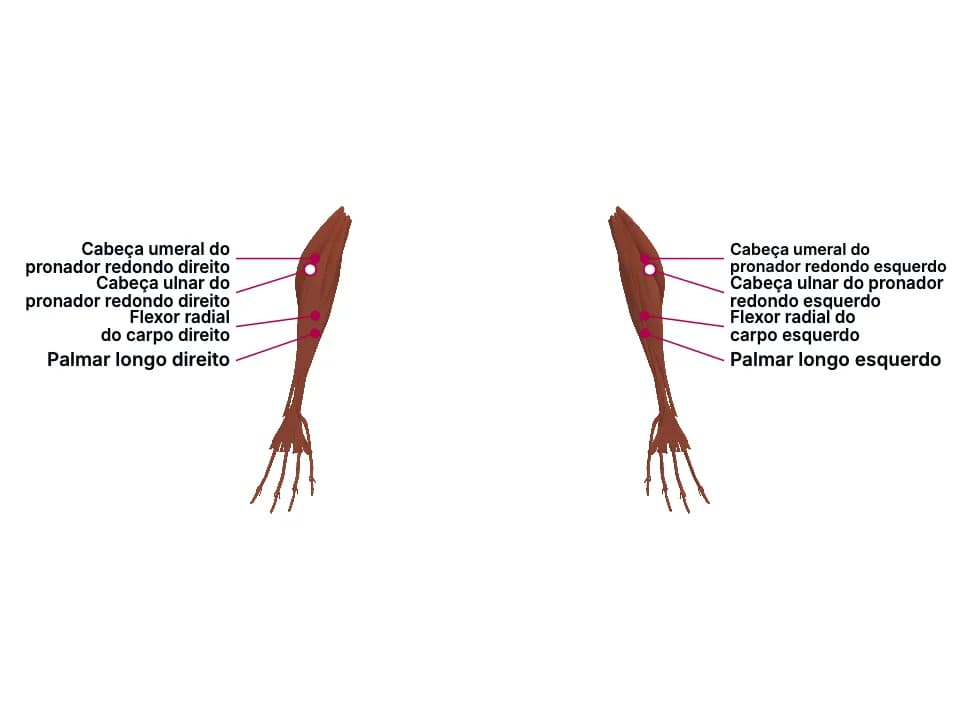
O pronador redondo tem duas cabeças: a umeral, maior e mais superficial, originada na crista supracondilar medial do úmero: 'The humeral head is the larger and more superficial head and originates on the medial supracondylar ridge of the humerus, just superior to the medial epicondyle.' e a ulnar, mais profunda, originada na apófise coronoide da ulna: 'The ulnar head lies deep to the humeral head and originates from the coronoid process of the ulna.'
Antes de as duas cabeças se unirem, o nervo mediano entra no antebraço passando ENTRE elas na maioria das pessoas: 'The median nerve enters the forearm between the two heads of the pronator teres, and the ulnar head separates the median nerve from the ulnar artery.' - quantificando essa maioria: 'Before the two heads unite, the median nerve passes between them in 74% to 82% of the cases' O próprio nervo mediano é quem inerva o pronador redondo, viajando por dentro desse mesmo hiato: 'The median nerve innervates the pronator teres as it travels through the pronator teres’ two heads originating from the humerus and the ulna.' A função do músculo é pronar o antebraço: 'As its name suggests, the primary function of the pronator teres is to pronate the forearm. Acting synergistically with the pronator quadratus, the pronator teres pulls the radius medially, which causes the radial head to rotate around the proximal ulna.'
O nervo mediano é comprimido, na síndrome do pronador redondo, no hiato ENTRE as duas cabeças do músculo, no antebraço PROXIMAL: 'Pronator teres syndrome (PTS), first described by Henrik Seyffarth in 1951, is caused by a compression of the median nerve (MN) by the pronator teres (PT) muscle in the forearm.' Mais adiante no seu trajeto, o mesmo nervo entra sob o retináculo flexor para atravessar o túnel do carpo, já no punho, DISTAL: 'Carpal tunnel syndrome (CTS) occurs when the median nerve is compressed as it traverses the carpal tunnel.' - 'The carpal tunnel is a narrow passageway in the wrist formed by the transverse carpal ligament at its upper boundary and the carpal bones at its lower boundary.'
O túnel do carpo, além do nervo mediano, acomoda os tendões flexores dos dedos: 'The carpal tunnel accommodates 9 flexor tendons and the median nerve, which traverses through it.' A apresentação clínica dos dois sítios de compressão é oposta quanto ao horário: na síndrome do pronador redondo, a parestesia noturna costuma estar ausente: 'nocturnal paresthesia symptoms are usually absent in pronator teres syndrome' - enquanto na síndrome do túnel do carpo, a piora noturna é justamente o que aponta para o diagnóstico: 'Symptoms that worsen at night indicate CTS, especially if the patient experiences relief by shaking the hand or wrist.'
O palmar longo é um músculo pequeno e fusiforme do antebraço anterior: 'The palmaris longus is a small, fusiform-shaped muscle located on the anterior forearm of the human upper extremity.' Sua contribuição à flexão do cotovelo e do punho é mínima: 'the muscle crosses the elbow and wrist joints and consequently contributes to flexion at these joints; however, the muscle is small, and the actual contribution is likely minimal as an accessory flexor at these joints.'
Ele está ausente numa fração variável da população - não um número único, mas uma faixa que depende do grupo estudado: 'The palmaris longus muscle is commonly present but may be absent in a small percentage of the population, ranging from 2.5% to 26% of individuals, depending on the studied population.' Quando ausente congenitamente, não há déficit funcional mensurável: 'Congenital absence of the muscle is common but has not demonstrated decreased grip strength or any other functional deficit.' Sua presença se testa clinicamente opondo o polegar ao dedo mínimo e flexionando o punho - o teste de Schaeffer: 'To perform the Schaeffer test, ask the patient to touch the pads of the thumb and little finger together while flexing the wrist, and if present, the tendon of palmaris longus should protrude anteriorly at the wrist joint.'
O flexor superficial dos dedos tem 2 origens: 'The flexor digitorum superficialis muscle has 2 origins. The humeroulnar head originates from the medial epicondyle of the humerus and the coronoid process of the ulna. The radial head originates on the upper half of the volar aspect of the radial shaft.' e é o flexor primário da interfalângica proximal (IFP) dos 4 dedos mediais: 'The flexor digitorum superficialis is the primary flexor of the proximal interphalangeal (PIP) joints of the middle phalanges, but it also assists in flexion of the metacarpophalangeal (MCP) joints.' O flexor profundo dos dedos se origina mais profundamente na ulna: 'The FDP originates from the proximal three-fourths of the medial and anterior ulnar surfaces and interosseous membrane.'
O flexor profundo é o ÚNICO músculo que flexiona a interfalângica distal (IFD) dos mesmos 4 dedos: 'The FDP flexes the distal phalanges of the medial 4 digits at the DIP joints and is the only muscle that can do so.' Essa exclusividade é o que permite testar os dois planos flexores separadamente, em direções opostas: bloqueando a IFP em extensão e pedindo a flexão ativa da IFD, testa-se o flexor profundo isolado - já que só ele atravessa essa articulação: 'Flexor digitorum profundus (FDP) can be isolated by blocking PIP flexion and assessing active DIP flexion, as FDP is the only flexor tendon to traverse the DIP joint.'
Na clínica
A compressão do nervo mediano nesse hiato é a síndrome do pronador redondo: 'Pronator teres syndrome (PTS), first described by Henrik Seyffarth in 1951, is caused by a compression of the median nerve (MN) by the pronator teres (PT) muscle in the forearm.' - manifestando-se como dor na região volar do antebraço, agravada pela pronação resistida e pela flexão do cotovelo: 'Pronator teres syndrome may manifest with pain in the volar forearm region, aggravated by resisted pronation of the forearm and flexion of the elbow' Uma variante rara - a ausência da própria cabeça ulnar - reduziria esse risco: 'The absence of the ulnar head is rare (14%) and may reduce the risk of median nerve entrapment.'
Além do horário, a distribuição sensitiva também difere: a síndrome do pronador redondo compromete todo o território sensitivo do nervo mediano, enquanto a síndrome do túnel do carpo poupa a eminência tenar - porque o ramo cutâneo palmar sai do nervo mediano antes do túnel do carpo, mas depois do pronador redondo: 'Pronator teres syndrome has a sensory loss in the entire median nerve distribution versus CTS, where sensation is spared over the thenar eminence because palmar cutaneous branch leaves the median nerve proximal to carpal tunnel but distal to PT muscle' Mesmo nervo, dois sítios de compressão, duas apresentações clínicas distintas.
A relevância clínica de checar a presença antes de agir: o tendão do palmar longo, quando presente, é um doador comum de enxerto tendíneo: 'The palmaris longus tendon is a commonly harvested structure for autogenous tendon grafting and other surgical procedures due to the length of the muscle's tendon, its superficial location and ease of access in the upper extremity' - e a mesma prevalência de ausência que não causa déficit funcional é o motivo de confirmar com o teste de Schaeffer antes de planejar colhê-lo.
E, inversamente, bloqueando os OUTROS 3 dedos em extensão - o que inativa o flexor profundo, de ventre muscular compartilhado entre eles -, isola-se o flexor superficial do dedo testado: 'Ask the patient to flex 1 out of the 4 medial fingers at the proximal interphalangeal joint against resistance, and the other 3 fingers are held in an extended position to inactivate the flexor digitorum profundus.' O ventre compartilhado que torna essa inativação possível é do flexor PROFUNDO, não do superficial: 'The 2 ulnar FDP tendons usually originate from the same muscle belly and separate in the forearm or carpal tunnel.' - o mesmo traço por trás do efeito quadriga (perda de movimento independente entre os tendões ulnares do flexor profundo): 'Immediate repair prevents DIP contractures and quadrigia or the FDP tendons' inability to move independently.'
Abrir o aprofundamento
Aprofundamento
O nervo mediano, ao entrar no antebraço e descer até o punho, estabelece três relações anatômicas distintas com músculos e ligamentos do compartimento flexor - cada uma com relevância clínica própria. A primeira: ele entra no antebraço passando entre as duas cabeças do pronador redondo: 'The median nerve enters the forearm between the two heads of the pronator teres, and the ulnar head separates the median nerve from the ulnar artery.'
Relação com as duas cabeças do pronador redondo (proximal, no antebraço) - o hiato entre a cabeça umeral e a cabeça ulnar é o sítio da síndrome do pronador redondo: 'Pronator teres syndrome (PTS), first described by Henrik Seyffarth in 1951, is caused by a compression of the median nerve (MN) by the pronator teres (PT) muscle in the forearm.' - com dor volar proximal e sem piora noturna: 'Pronator teres syndrome may manifest with pain in the volar forearm region, aggravated by resisted pronation of the forearm and flexion of the elbow' - 'nocturnal paresthesia symptoms are usually absent in pronator teres syndrome'; Relação com as duas origens do flexor superficial dos dedos (intermediária, mais adiante no antebraço) - um fato puramente anatômico, sem síndrome atribuída nesta unidade: o flexor superficial também tem duas origens, a cabeça umeroulnar e a cabeça radial: 'The flexor digitorum superficialis muscle has 2 origins. The humeroulnar head originates from the medial epicondyle of the humerus and the coronoid process of the ulna. The radial head originates on the upper half of the volar aspect of the radial shaft.'; Relação com o retináculo flexor sob o qual atravessa o túnel do carpo (distal, no punho) - o sítio da síndrome do túnel do carpo, com piora noturna característica, ao contrário do sítio proximal: 'Carpal tunnel syndrome (CTS) occurs when the median nerve is compressed as it traverses the carpal tunnel.' - 'The carpal tunnel is a narrow passageway in the wrist formed by the transverse carpal ligament at its upper boundary and the carpal bones at its lower boundary.' - 'Symptoms that worsen at night indicate CTS, especially if the patient experiences relief by shaking the hand or wrist.'
Teste-se antes de seguir
Um paciente sente dor na região VOLAR e PROXIMAL do antebraço, agravada quando é pedido que gire a palma para baixo contra resistência. Que estrutura muscular provável está comprimindo um nervo nesse ponto, e ONDE exatamente, em relação a essa estrutura, o nervo está sendo comprimido?
A resposta fica na Avaliação, sem spoiler aqui.
Responder na AvaliaçãoFontes (7)
- Luxenburg D, Rizzo MG. Anatomy, Shoulder and Upper Limb, Pronator Teres. [Updated 2023 May 1]. In: StatPearls [Internet]. Treasure Island (FL): StatPearls Publishing; 2026 Jan-.
The humeral head is the larger and more superficial head and originates on the medial supracondylar ridge of the humerus, just superior to the medial epicondyle.
- Dididze M, Tafti D, Sherman AL. Pronator Teres Syndrome. [Updated 2023 Jul 3]. In: StatPearls [Internet]. Treasure Island (FL): StatPearls Publishing; 2026 Jan-.
Before the two heads unite, the median nerve passes between them in 74% to 82% of the cases
- Sevy JO, Sina RE, Varacallo MA. Carpal Tunnel Syndrome. [Updated 2023 Oct 29]. In: StatPearls [Internet]. Treasure Island (FL): StatPearls Publishing; 2026 Jan-.
Carpal tunnel syndrome (CTS) occurs when the median nerve is compressed as it traverses the carpal tunnel.
- Cooper DW, Burns B. Anatomy, Shoulder and Upper Limb, Hand Palmaris Tendon. [Updated 2023 Aug 28]. In: StatPearls [Internet]. Treasure Island (FL): StatPearls Publishing; 2026 Jan-.
The palmaris longus is a small, fusiform-shaped muscle located on the anterior forearm of the human upper extremity.
- Okafor L, Varacallo MA. Anatomy, Shoulder and Upper Limb, Hand Flexor Digitorum Superficialis Muscle. [Updated 2022 Oct 17]. In: StatPearls [Internet]. Treasure Island (FL): StatPearls Publishing; 2026 Jan-.
The flexor digitorum superficialis muscle has 2 origins. The humeroulnar head originates from the medial epicondyle of the humerus and the coronoid process of the ulna. The radial head originates on the upper half of the volar aspect of the radial shaft.
- Lung BE, Burns B. Anatomy, Shoulder and Upper Limb, Hand Flexor Digitorum Profundus Muscle. [Updated 2023 Nov 13]. In: StatPearls [Internet]. Treasure Island (FL): StatPearls Publishing; 2026 Jan-.
The FDP originates from the proximal three-fourths of the medial and anterior ulnar surfaces and interosseous membrane.
- Stevens KA, Caruso JC, Fallahi AKM, Patiño JM. Flexor Tendon Lacerations. [Updated 2023 Jun 20]. In: StatPearls [Internet]. Treasure Island (FL): StatPearls Publishing; 2026 Jan-.
Flexor digitorum profundus (FDP) can be isolated by blocking PIP flexion and assessing active DIP flexion, as FDP is the only flexor tendon to traverse the DIP joint.
Onde isso cai na prática
1 caso clínico do acervo exige este tema. Veja onde ele decide a conduta.
Cozinheira com formigamento na mão direita há quatro meses: conduta na UBS
Ortopedia e traumatologia
Abrir o caso grátis
Mais resumos de Anatomia
Depois de ler, use o que aprendeu
Atlas
Veja as estruturas do tema em 3D e navegue por camadas.
Caso clínico
Aplique o conteúdo numa decisão de plantão.
Exame
Interprete o resultado que fecha o raciocínio.
Avaliação
Responda as perguntas dos blocos e veja onde você está.
Tutor de IA
Tire a dúvida que o texto não resolveu.
Comece grátis: crie a conta e prove uma amostra do Atlas em 3D, do caso clínico, do exame, da avaliação e do tutor de IA. Sem cartão de crédito.
Começar grátis