Hipófise, suprarrenais e pineal: eixo hormonal e o achado incidental na imagem
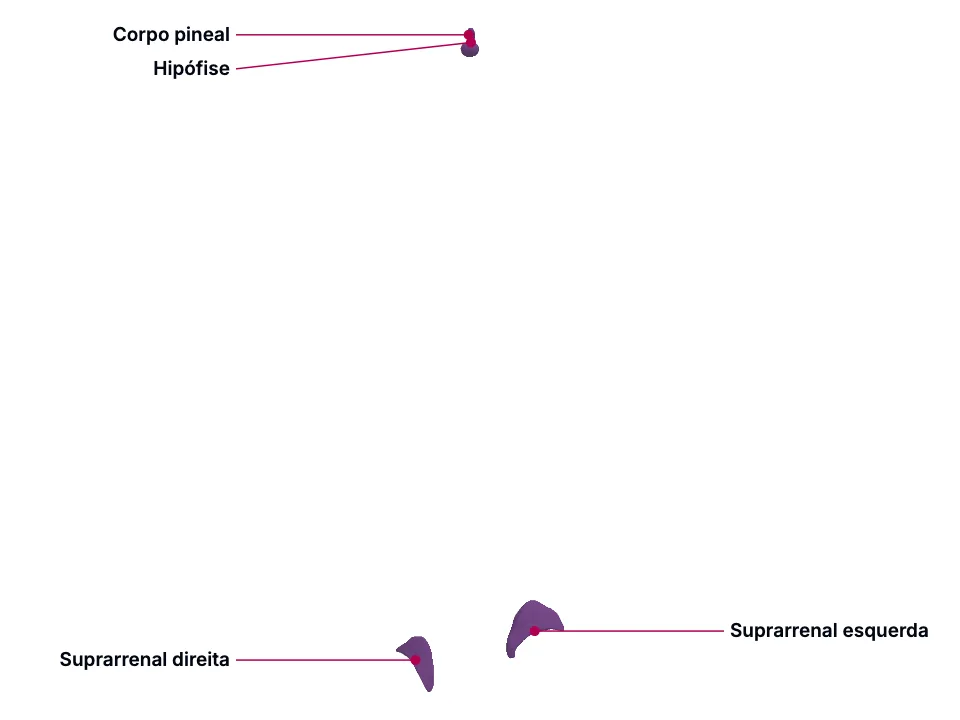
A hipófise tem origem embrionária dupla - lobo anterior glandular e secretor, lobo posterior apenas um depósito de hormônio hipotalâmico -, e a suprarrenal repete o mesmo padrão em folhetos germinativos opostos, com um córtex mesodérmico regulado pelo eixo hormonal hipófise-suprarrenal envolvendo uma medula de crista neural regulada por nervo direto. Essa dupla origem explica por que a doença de cada metade é distinta e por que hipófise e suprarrenal aparecem, na prática, como achado incidental de imagem que exige avaliação funcional antes de qualquer conduta. A pineal, que se desenvolve do mesmo teto do terceiro ventrículo que também origina o lobo posterior da hipófise, inverte essa lógica: sua calcificação normal com a idade não é achado a investigar, mas o marco que o próprio radiologista usa para ler a imagem.
Material educacional escrito com apoio de IA e conferido por revisão automatizada, sem revisão médica nomeada. Não substitui o livro-texto nem orientação clínica.
Essencial
A hipófise fica na sela túrcica do osso esfenoide e carrega o apelido de 'glândula mestra': It has the pseudonym of "the master gland." Ela se divide em lobo anterior (adeno-hipófise) e lobo posterior (neuro-hipófise), e é o lobo anterior que secreta a maior parte dos hormônios da glândula, sob regulação do hipotálamo: 'The anterior lobe secretes the majority of hormones from the pituitary gland, which are under the regulation of the hormones secreted from the hypothalamus.' O quiasma óptico fica imediatamente acima e à frente da glândula: 'The optic chiasm lies anterosuperior to the gland.'
Essa proximidade com o quiasma óptico não é acaso de vizinhança: a hipófise tem origem embriológica DUPLA - 'The pituitary gland has a dual origin. The oral ectoderm gives origin to the adenohypophysis, and the neural ectoderm gives origin to the neurohypophysis.' - e é justamente o lobo anterior, de origem no ectoderma oral (a bolsa de Rathke), que forma tecido glandular secretor verdadeiro, capaz de originar tumor; o lobo posterior, ao contrário, é uma extensão do sistema nervoso central que só armazena e libera hormônios já sintetizados pelo hipotálamo, sem sintetizar nada: 'The posterior pituitary is not glandular, like the anterior pituitary. Thus they do not synthesize hormones.' É por isso que a doença tumoral secretora da hipófise é, na prática, sempre doença do lobo anterior.
A suprarrenal é formada por córtex e medula: 'The adrenal gland is made up of the cortex and medulla. The cortex produces steroid hormones including glucocorticoids, mineralocorticoids, and adrenal androgens, and the medulla produces the catecholamines, epinephrine, and norepinephrine.' Só a medula tem a enzima que converte noradrenalina em adrenalina: 'Once norepinephrine has been created, it is then methylated via phenylethanolamine N-methyltransferase (PNMT), which is only present in the adrenal medulla.'
Essa divisão funcional reflete uma origem embriológica dupla, análoga à da hipófise, mas com as camadas germinativas trocadas: 'The adrenal gland comprises 2 embryologically distinct tissues containing 2 different forms of signaling chemicals. One is the outer cortex of mesodermal origin, which produces steroid hormones. The other is a medulla that is derived from neuroectoderm and secretes catecholamines.' - confirmado de forma independente pela fonte de fisiologia: 'The adrenal cortex is derived from mesoderm and begins posteromedial to the urogenital ridge. The adrenal medulla is derived from neural crest cells.' As células da crista neural migram para dentro da glândula já na 7a semana: 'During the 7th week of development, neural crest cells formed at the apex of the neural folds migrate into the adrenal primordium via a ventral pathway.', e o córtex acaba envolvendo por completo essa medula: 'The cortex engulfs and gradually encapsulates the whole medulla in the later stages of embryonic development.' Essa origem dupla explica por que as duas partes têm sistemas de controle diferentes: o córtex é regulado pelo eixo hormonal hipófise-suprarrenal - 'Adrenocorticotropic hormone (ACTH) secreted from the anterior pituitary gland activates the adrenal cortex.' -, enquanto a medula é inervada diretamente por fibra simpática pré-ganglionar, sem depender de hormônio circulante: 'However, the adrenal medulla is innervated by preganglionic nerve fibers (type B) arising from the intermediolateral cell column of the spinal cord's lateral horn from the T5–T8 spinal cord segments.' - o que faz da medula, nas palavras da própria fonte, 'This is why the adrenal medulla acts as a neuroendocrine junction between the 2 physiological segments.'
Um microadenoma hipofisário é, na maioria das vezes, um achado casual de exame de imagem, não uma queixa: 'Pituitary adenomas are often found incidentally during imaging.' 'Most incidental findings are microadenomas, which are usually clinically silent.' 'Pituitary microadenoma is usually found incidentally on an MRI of the brain.' Na suprarrenal, o mesmo padrão se repete numa proporção mensurável dos exames: 'These adrenal masses occur more frequently than expected and can approach up to 4% of CT scans.'
Nos dois órgãos, o algoritmo de conduta ignora o motivo do exame e faz sempre a MESMA pergunta central antes de decidir entre observação e intervenção - a lesão é hormonalmente funcionante? 'An algorithm for adrenal incidentaloma includes addressing if the tumor is functional. Appropriate adrenal functional tests, such as the low-dose dexamethasone suppression test, plasma metanephrines, and plasma aldosterone, should be performed.' Quando a suprarrenal é pequena e não funcionante, a conduta é reexame por imagem, não cirurgia: 'If there is no history of cancer and the adrenal incidentaloma is less than 4 cm, CT should be repeated in 4 to 6 months.'
Na clínica
Um adenoma hipofisário se classifica por tamanho - 'They classify into microadenomas (less than 10 mm) and macroadenomas (more than 10 mm).' - e é o macroadenoma, ao crescer para cima em direção ao quiasma óptico logo acima da glândula, que produz o efeito de massa clássico: 'A nonfunctioning adenoma only gets surgically resected when the tumor causes compression or mass effect to the adjacent structures like the optic chiasm causing bitemporal hemianopsia field defect.' O padrão de perda visual é bitemporal porque a compressão atinge especificamente as fibras nasais da retina, que se cruzam dentro do próprio quiasma: 'This specific visual field defect is due to the compression of the nasal retinal fibers that decussate within the optic chiasm.' Esse efeito de massa ocorre em boa parte dos casos: 'Visual field defect occurs in approximately 40% to 60% of patients from suprasellar extension of the pituitary adenoma, which compresses the optic chiasm, leading to visual field defects (bitemporal hemianopia).'
Por serem, na prática, duas glândulas dentro de uma cápsula, a doença de cada parte é bioquímica e clinicamente distinta: excesso de cortisol na zona fasciculada produz a síndrome de Cushing - 'Zona Fasiculata: Cushing disease manifests by elevated levels of cortisol, resulting in abdominal striae with significant central obesity, buffalo hump of the nape of the neck, and hyperglycemia.' -, excesso de aldosterona na glomerulosa produz a síndrome de Conn - 'Conn syndrome is manifested by hyperaldosteronism, which excites the renin-aldosterone-angiotensin system (RAA).' (NOTA: a fonte usa 'excites', mas o achado clássico que distingue hiperaldosteronismo PRIMÁRIO do secundário é justamente o oposto: a aldosterona alta SUPRIME a renina, por retroalimentação negativa - é essa supressão, não uma excitação, que confirma a origem adrenal autônoma da doença) -, e um tumor da medula (feocromocitoma) libera catecolaminas em excesso. Por isso, na cirurgia de um feocromocitoma, a veia adrenal precisa ser ligada ANTES de qualquer manipulação do tumor: 'When removing a pheochromocytoma, a neuroendocrine tumor based on the adrenal medulla's chromaffin cells that produce large amounts of catecholamines, it is crucial to ligate the adrenal vein before manipulating the organ.' - sem essa ligadura prévia, a manipulação provoca uma descarga aguda de catecolaminas: 'If the adrenal vein is not ligated before manipulating the gland, the pheochromocytoma can release significant levels of catecholamines into the systemic circulation; this causes a catecholamine rush, resulting in a rapid onset of severe hypertension and tachycardia.'
Achado incidental não é sinônimo de achado sem risco: 'Microadenomas are often incidental findings, while macroadenomas may cause visual impairment, headaches, or hypopituitarism from compression of surrounding structures.' O próprio padrão de diagnóstico do feocromocitoma mudou por esse motivo - de investigação de hipertensão secundária para achado de imagem por outro motivo. Em ambos os órgãos, é a avaliação FUNCIONAL, não o motivo do exame, que decide a conduta.
Abrir o aprofundamento
Aprofundamento
O neuroectoderma do terceiro ventrículo (diencéfalo), que dá origem a duas estruturas independentes deste bundle: o lobo posterior da hipófise, por uma extensão do ASSOALHO - 'The posterior lobe is smaller and derives from the outpouching of the third ventricle neural primordia. Thus it is an extension of the central nervous system.' -, e a glândula pineal, por uma evaginação do TETO - 'The development of the pineal gland occurs from the third ventricle roof, the caudal-most portion. At the seventh week of intrauterine development, the ependymal area of the roof of the third ventricle thickens.'
Lobo posterior da hipófise (neuro-hipófise) - permanece uma extensão do sistema nervoso central que armazena e libera, mas não sintetiza, hormônios feitos no hipotálamo: 'The hormones are synthesized by the magnocellular neurons located in the supraoptic and paraventricular nuclei of the hypothalamus.' É 'The posterior pituitary is neural in origin. Unlike the anterior pituitary, the posterior pituitary is connected directly to the hypothalamus via a nerve tract (hypothalamohypophyseal nerve tract). It secretes two hormones: oxytocin and antidiuretic hormone (ADH) or vasopressin.'; Glândula pineal - desenvolve-se do teto do terceiro ventrículo a partir da 7a semana de vida intrauterina, e na vida adulta acumula calcificação (corpora arenacea) visível ao raio-x, usada como marco radiológico: 'The pineal gland is sometimes used as a landmark (when calcified) to identify different brain structures and areas on an x-ray.'
Teste-se antes de seguir
Por que um macroadenoma hipofisário produz classicamente uma hemianopsia BITEMPORAL, e não outro padrão de perda de campo visual?
A resposta fica na Avaliação, sem spoiler aqui.
Responder na AvaliaçãoFontes (6)
- Ganapathy MK, Tadi P. Anatomy, Head and Neck, Pituitary Gland. [Updated 2023 Jul 24]. In: StatPearls [Internet]. Treasure Island (FL): StatPearls Publishing; 2026 Jan-.
It has the pseudonym of "the master gland."
- Shafiq I, Anastasopoulou C. Pituitary Adenoma. [Updated 2025 Nov 7]. In: StatPearls [Internet]. Treasure Island (FL): StatPearls Publishing; 2026 Jan-.
Visual field defect occurs in approximately 40% to 60% of patients from suprasellar extension of the pituitary adenoma, which compresses the optic chiasm, leading to visual field defects (bitemporal hemianopia).
- Dutt M, Wehrle CJ, Jialal I. Physiology, Adrenal Gland. [Updated 2023 May 1]. In: StatPearls [Internet]. Treasure Island (FL): StatPearls Publishing; 2026 Jan-.
The adrenal gland is made up of the cortex and medulla. The cortex produces steroid hormones including glucocorticoids, mineralocorticoids, and adrenal androgens, and the medulla produces the catecholamines, epinephrine, and norepinephrine.
- Megha R, Wehrle CJ, Kashyap S, Leslie SW. Anatomy, Abdomen and Pelvis: Adrenal Glands (Suprarenal Glands). [Updated 2022 Oct 17]. In: StatPearls [Internet]. Treasure Island (FL): StatPearls Publishing; 2026 Jan-.
Once norepinephrine has been created, it is then methylated via phenylethanolamine N-methyltransferase (PNMT), which is only present in the adrenal medulla.
- Kamel-ElSayed SA, Schwartz J. Physiology, Pituitary Gland. [Updated 2023 May 1]. In: StatPearls [Internet]. Treasure Island (FL): StatPearls Publishing; 2026 Jan-.
The posterior pituitary is neural in origin. Unlike the anterior pituitary, the posterior pituitary is connected directly to the hypothalamus via a nerve tract (hypothalamohypophyseal nerve tract). It secretes two hormones: oxytocin and antidiuretic hormone (ADH) or vasopressin.
- Ilahi S, Beriwal N, Ilahi TB. Physiology, Pineal Gland. [Updated 2023 Apr 24]. In: StatPearls [Internet]. Treasure Island (FL): StatPearls Publishing; 2026 Jan-.
The development of the pineal gland occurs from the third ventricle roof, the caudal-most portion. At the seventh week of intrauterine development, the ependymal area of the roof of the third ventricle thickens.
Mais resumos de Anatomia
Depois de ler, use o que aprendeu
Atlas
Veja as estruturas do tema em 3D e navegue por camadas.
Caso clínico
Aplique o conteúdo numa decisão de plantão.
Exame
Interprete o resultado que fecha o raciocínio.
Avaliação
Responda as perguntas dos blocos e veja onde você está.
Tutor de IA
Tire a dúvida que o texto não resolveu.
Comece grátis: crie a conta e prove uma amostra do Atlas em 3D, do caso clínico, do exame, da avaliação e do tutor de IA. Sem cartão de crédito.
Começar grátis