Músculos supra e infra-hióideos: o assoalho da deglutição
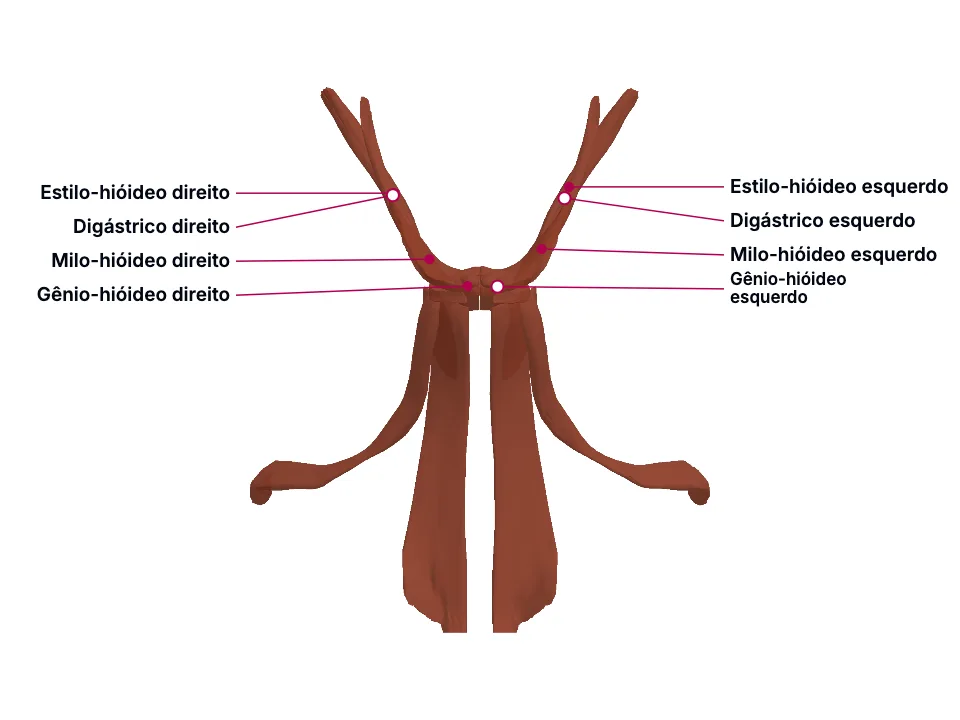
O grupo supra-hióideo (digástrico, milo-hióideo, gênio-hióideo, estilo-hióideo) eleva o hioide e o assoalho da boca na deglutição, e o infra-hióideo (esterno-hióideo, tireo-hióideo, omo-hióideo) faz o papel oposto e complementar, deprimindo o hioide depois - com o tireo-hióideo também elevando a laringe para ajudar a abrir o esfíncter esofágico superior. Esses músculos delimitam os triângulos cervicais anteriores do exame de massa de pescoço (o digástrico subdivide o anterior em submandibular e submentual) e o ventre posterior do digástrico é reparo cirúrgico clássico do nervo facial na parotidectomia. Por fim, os sete músculos recebem inervação de quatro fontes nervosas diferentes (trigêmeo, facial, hipoglosso com fibras de C1, e alça cervical), o que faz uma disfagia neurogênica desse território localizar a lesão de forma seletiva, conforme qual músculo especificamente falha.
Material educacional escrito com apoio de IA e conferido por revisão automatizada, sem revisão médica nomeada. Não substitui o livro-texto nem orientação clínica.
Essencial
O pescoço organiza parte de sua musculatura pela relação com o osso hioide: 'Muscles above the hyoid bone are termed "suprahyoid muscles," while those below are called "infrahyoid muscles."' O grupo supra-hióideo reúne quatro músculos - digástrico, milo-hióideo, gênio-hióideo e estilo-hióideo -, e 'Suprahyoid muscles facilitate chewing, swallowing, and phonation.' Junto dos infra-hióideos, eles estabilizam um osso que não se articula com nenhum outro: 'Along with the infrahyoid muscles, suprahyoid muscles stabilize the hyoid, which lacks articulation with other bones.'
O mecanismo comum ao grupo é elevar o hioide e o assoalho da boca quando a mandíbula está estabilizada: 'These muscles suspend the hyoid bone superiorly and contribute to its elevation, along with the floor of the mouth, during deglutition when the mandible remains stable.' O digástrico contribui como um dos três supra-hióideos que estabilizam o hioide durante a deglutição, protegendo a via aérea: 'The anterior belly of the digastric is 1 of 3 suprahyoid muscles stabilizing the hyoid during swallowing' - e, com os outros, 'The digastrics raise the tongue base and hyoid bone and depress the mandible for jaw opening, chewing, and speech.' O estilo-hióideo faz sua parte puxando o hioide para cima e para trás: 'Stylohyoid pulls the hyoid bone backward and upward, which elevates the tongue and elongates the floor of the mouth, aiding in deglutition.' E o milo-hióideo, especificamente, eleva o hioide e a cavidade oral: 'The mylohyoid mainly functions to elevate the hyoid bone, elevate the oral cavity, and depress the mandible.'
O grupo infra-hióideo, também chamado de grupo dos músculos abaixo do hioide, reúne quatro músculos pareados: 'The strap muscles, also known as the infrahyoid muscles, consist of four paired muscles' - o esterno-hióideo, o esterno-tireóideo, o tireo-hióideo e o omo-hióideo (esta unidade cobre os três primeiros, exceto o esterno-tireóideo). O papel do grupo é oposto ao dos supra-hióideos: 'Contraction of the suprahyoid muscles will elevate the hyoid bone while contraction of the infrahyoid muscles will depress the hyoid bone.'
Especificamente, 'The omohyoid, sternohyoid, and thyrohyoid act to depress the hyoid bone. The thyrohyoid elevates the larynx, whereas the sternothyroid depresses the larynx.' O esterno-hióideo, em particular, trabalha em conjunto com os outros infra-hióideos para deprimir o hioide: 'The primary function of the sternohyoid muscle is to work in sync with the other infrahyoid muscles to depress the hyoid bone.' O tireo-hióideo é o caso especial do grupo: quando ele contrai com o hioide fixo (em vez do inverso), o efeito é elevar a laringe, aproximando-a do hioide - e é essa aproximação que ajuda a iniciar a abertura do esfíncter esofágico superior no fim da fase faríngea da deglutição: 'contraction of the thyrohyoid to move the larynx and hyoid superiorly and anteriorly, thereby initiating the opening of the sphincter'
O digástrico tem dois ventres, anterior e posterior, ligados por um tendão intermédio: 'The digastrics are a pair of muscles so named as each has an anterior and a posterior belly' Os dois ventres vêm de arcos faríngeos diferentes, e por isso têm inervação diferente: 'The anterior digastric belly and mylohyoid nerve form from the 1st pharyngeal arch, also known as the mandibular arch. The posterior digastric belly and the facial nerve derive from the 2nd pharyngeal arch, also known as the hyoid arch.' - o nervo facial supre o ventre posterior, o nervo milo-hióideo (ramo do trigêmeo) supre o anterior: 'Despite forming a single muscle, the 2 bellies receive innervation from different nerves due to their distinct embryological origins. The facial nerve supplies the posterior belly, while the mylohyoid branch of the inferior alveolar nerve, a branch of the mandibular nerve, innervates the anterior belly.'
Na parotidectomia, o cirurgião usa exatamente o ventre posterior como referência para achar o nervo facial: 'The tail of the parotid is retracted superiorly, and the digastric muscle is identified. The muscle serves as a landmark for the facial nerve.' A referência óssea específica é a inserção do ventre posterior na ponta da mastoide: 'The posterior belly of the digastric inserts into the mastoid tip, so tissue superficial to this structure can be divided with relative impunity once the distal marginal mandibular branch has been located.'
O triângulo cervical anterior se subdivide em quatro sub-triângulos: 'The anterior triangle is further divided into 4 subtriangles. The submandibular and submental triangles form the superior divisions, whereas the muscular and carotid triangles constitute the inferior divisions of the anterior neck.' Dois deles, os mais superiores, são delimitados diretamente pelo digástrico: 'The submandibular triangle is delineated by the inferior border of the mandible and the anterior and posterior bellies of the digastric muscle. The submental triangle, located medial to the submandibular triangle, is bounded by the hyoid bone, the anterior belly of the digastric, and the midline of the neck.'
Detalhando o submandibular: 'The submandibular triangle is bounded anteriorly by the anterior belly of the digastric muscle and posteriorly by the posterior belly of the digastric muscle.' - com o milo-hióideo formando o assoalho: 'The triangle's floor is formed by the mylohyoid muscle.' O submentual, por sua vez: 'The submental triangle is the only unpaired triangle of the anterior triangle of the neck. It is limited by the body of the hyoid bone and the anterior bellies of the digastric muscle.' - e 'The anterior bellies of the digastric muscle, which attach to the digastric fossa, separate the submental from the submandibular triangle.' Os dois sub-triângulos mais inferiores, o muscular e o carotídeo, usam outros dois músculos do grupo hioideo como referência: 'The muscular triangle is outlined by the anterior border of the SCM, the superior belly of the omohyoid muscle, the midline of the neck, and the hyoid. The carotid triangle lies between the anterior border of the SCM, the superior belly of the omohyoid, and the posterior belly of the digastric, with the stylohyoid muscle running along its superior margin.'
Na clínica
Quando o hioide já está fixado pela ação dos infra-hióideos, o mesmo grupo supra-hióideo passa a produzir outro movimento: a depressão da mandíbula, abrindo bem a boca: 'When the infrahyoid muscles stabilize the hyoid bone, the suprahyoid muscles contribute to mandibular depression, facilitating a wide opening of the mouth.' É esse duplo repertório - elevar o hioide com a mandíbula fixa, ou abrir a mandíbula com o hioide fixo - que torna o grupo supra-hióideo indispensável tanto na deglutição quanto na mastigação e na fala.
O resultado clínico é um ciclo funcional: os supra-hióideos elevam o hioide e a laringe para proteger a via aérea durante a passagem do bolo alimentar, e os infra-hióideos - com o tireo-hióideo cumprindo essa dupla função de elevar a laringe OU deprimir o hioide - trazem a laringe de volta à posição de repouso depois. Um grupo não substitui o outro: a deglutição normal depende da sequência dos dois papéis, opostos mas complementares.
O motivo de usar justamente essa referência é de segurança: dissecar ACIMA do digástrico arrisca lesar o próprio nervo que ele ajuda a localizar, no ponto em que esse nervo sai do crânio: 'Dissection cephalad to the digastric muscle might injure the facial nerve as it exits the stylomastoid foramen between the mastoid and styloid processes.' É a mesma lógica, em espelho, do que a inervação do digástrico já ensina - o ventre posterior e o nervo facial nascem do mesmo arco faríngeo (o 2o), o que explica por que um serve de marco anatômico tão consistente para o outro.
Essa geografia importa para localizar uma massa cervical: o conteúdo do triângulo submandibular é principalmente a glândula submandibular: 'The majority of the space within the triangle is taken up by the submandibular gland that helps produce salivary fluid secreted into the oral cavity.' - enquanto o submentual abriga os linfonodos submentuais, relevantes como indicadores de metástase: 'The submental triangle harbors the submental lymph nodes that drain the mental region, the tip of the tongue, inferior lip, and incisor teeth.' Saber qual ventre do digástrico limita cada triângulo é o que permite ao examinador nomear, e não só apontar, onde uma massa está.
Abrir o aprofundamento
Aprofundamento
Os 7 músculos hioideos (digástrico, milo-hióideo, gênio-hióideo, estilo-hióideo, esterno-hióideo, tireo-hióideo, omo-hióideo) convergem para o mesmo osso, mas nascem de arcos faríngeos diferentes - e por isso recebem inervação de fontes diferentes: 'Among the 4 suprahyoid muscles, the mylohyoid and the anterior belly of the digastric originate from the mesoderm of the 1st pharyngeal (branchial) arch and receive innervation from the mandibular nerve, the 3rd division of the trigeminal nerve (cranial nerve V3). In contrast, the posterior belly of the digastric and the stylohyoid develop from the mesoderm of the 2nd pharyngeal arch and are innervated by the facial nerve (cranial nerve VII).'
Nervo trigêmeo (V3) - inerva o milo-hióideo e o ventre anterior do digástrico, pelo MESMO ramo (o nervo milo-hióideo): 'The mylohyoid and the anterior belly of the digastric muscle receive innervation from the mylohyoid nerve, a branch of the inferior alveolar nerve, which arises from the mandibular nerve.' Confirmado, de forma independente, pela própria fonte do digástrico: 'The inferior alveolar nerve then courses through the mylohyoid canal before giving off motor branches to both the mylohyoid muscle and the anterior digastric belly.' e pela do milo-hióideo: 'The mylohyoid nerve innervates the mylohyoid muscle. The inferior alveolar nerve is a branch from the posterior division of the mandibular division (V3) of CN V (trigeminal nerve). The mylohyoid nerve is a branch of the inferior alveolar nerve which contains both sensory and motor components.'; Nervo facial (VII) - inerva o ventre posterior do digástrico e o estilo-hióideo, também pelo MESMO ramo: 'The facial nerve innervates the stylohyoid and the posterior belly of the digastric muscle.' O estilo-hióideo compartilha essa inervação com o ventre posterior por correrem lado a lado: 'The stylohyoid runs alongside the posterior belly of the digastric muscle, and both share innervation from the facial nerve.' - 'After exiting the stylomastoid foramen, the digastric branch of the facial nerve supplies the posterior bellies of the digastric muscle and the stylohyoid muscles.'; Nervo hipoglosso (XII), carregando fibras de C1 - inerva o gênio-hióideo: 'The geniohyoid muscle receives its nerve supply from the first cervical nerve via the hypoglossal nerve.' O tireo-hióideo usa uma via PARECIDA mas DISTINTA: não é o hipoglosso motor, e sim uma raiz da alça cervical (fibras de C1) que viaja ao lado do hipoglosso antes de se separar dele: 'The thyrohyoid muscle also receives nerve supply from the superior ansa cervicalis, which goes alongside the hypoglossal nerve.' - por isso o tireo-hióideo NÃO entra no mesmo balde da alça cervical clássica que serve esterno-hióideo e omo-hióideo, nem no mesmo balde do hipoglosso puro que serve o gênio-hióideo.; Alça cervical (C1-C3), a raiz do plexo cervical - inerva o esterno-hióideo e o omo-hióideo, pelo MESMO nervo: 'The nerve innervation to the sternohyoid muscle derives from the first, second, and third cervical nerve roots (C1-C3). These nerve roots form a plexus called the ansa cervicalis. The ansa cervicalis provides motor innervation to the sternohyoid muscle. The ansa cervicalis nerve also innervates the omohyoid muscle and the sternohyoid muscle.' Confirmado, de forma independente, por uma segunda fonte: 'The infrahyoid muscles are innervated by the deep ansa cervicalis (C1-C3), a branch of the cervical plexus.'
Teste-se antes de seguir
Um paciente com paralisia do nervo facial de um lado consegue depressão normal da mandíbula (abrir bem a boca), mas mostra fraqueza discreta na elevação do hioide desse lado durante a deglutição. Quais DOIS músculos supra-hióideos explicam essa fraqueza seletiva, e por que os outros dois supra-hióideos permanecem normais?
A resposta fica na Avaliação, sem spoiler aqui.
Responder na AvaliaçãoFontes (11)
- Khan YS, Fakoya AO, Bordoni B. Anatomy, Head and Neck: Suprahyoid Muscle. [Updated 2025 Mar 25]. In: StatPearls [Internet]. Treasure Island (FL): StatPearls Publishing; 2026 Jan-.
Muscles above the hyoid bone are termed "suprahyoid muscles," while those below are called "infrahyoid muscles."
- Tranchito EN, Bordoni B. Anatomy, Head and Neck, Digastric Muscle. [Updated 2024 Jan 30]. In: StatPearls [Internet]. Treasure Island (FL): StatPearls Publishing; 2026 Jan-.
The anterior belly of the digastric is 1 of 3 suprahyoid muscles stabilizing the hyoid during swallowing
- Toth J, Lappin SL. Anatomy, Head and Neck, Mylohyoid Muscle. [Updated 2023 Jun 5]. In: StatPearls [Internet]. Treasure Island (FL): StatPearls Publishing; 2026 Jan-.
The mylohyoid mainly functions to elevate the hyoid bone, elevate the oral cavity, and depress the mandible.
- Mnatsakanian A, Al Khalili Y. Anatomy, Head and Neck, Thyroid Muscles. [Updated 2023 Jul 24]. In: StatPearls [Internet]. Treasure Island (FL): StatPearls Publishing; 2026 Jan-.
The strap muscles, also known as the infrahyoid muscles, consist of four paired muscles
- Nguyen JD, Duong H. Anatomy, Head and Neck, Sternohyoid Muscle. [Updated 2023 Jul 24]. In: StatPearls [Internet]. Treasure Island (FL): StatPearls Publishing; 2026 Jan-.
Contraction of the suprahyoid muscles will elevate the hyoid bone while contraction of the infrahyoid muscles will depress the hyoid bone.
- Panara K, Ramezanpour Ahangar E, Padalia D. Physiology, Swallowing. [Updated 2023 Jul 24]. In: StatPearls [Internet]. Treasure Island (FL): StatPearls Publishing; 2026 Jan-.
contraction of the thyrohyoid to move the larynx and hyoid superiorly and anteriorly, thereby initiating the opening of the sphincter
- El Sayed Ahmad Y, Winters R. Parotidectomy. [Updated 2026 Jun 17]. In: StatPearls [Internet]. Treasure Island (FL): StatPearls Publishing; 2026 Jan-.
The tail of the parotid is retracted superiorly, and the digastric muscle is identified. The muscle serves as a landmark for the facial nerve.
- Stathakios J, Jozsa F. Anatomy, Head and Neck, Neck Triangle. [Updated 2026 Mar 21]. In: StatPearls [Internet]. Treasure Island (FL): StatPearls Publishing; 2026 Jan-.
The anterior triangle is further divided into 4 subtriangles. The submandibular and submental triangles form the superior divisions, whereas the muscular and carotid triangles constitute the inferior divisions of the anterior neck.
- Casale J, Varacallo MA. Anatomy, Head and Neck, Submandibular Triangle. [Updated 2023 Aug 21]. In: StatPearls [Internet]. Treasure Island (FL): StatPearls Publishing; 2026 Jan-.
The submandibular triangle is bounded anteriorly by the anterior belly of the digastric muscle and posteriorly by the posterior belly of the digastric muscle.
- Al-Missri MZ, Al Khalili Y. Anatomy, Head and Neck, Submental Triangle. [Updated 2023 May 29]. In: StatPearls [Internet]. Treasure Island (FL): StatPearls Publishing; 2026 Jan-.
The submental triangle is the only unpaired triangle of the anterior triangle of the neck. It is limited by the body of the hyoid bone and the anterior bellies of the digastric muscle.
- Rathee M, Jain P. Anatomy, Head and Neck, Stylohyoid Muscle. [Updated 2023 Jan 30]. In: StatPearls [Internet]. Treasure Island (FL): StatPearls Publishing; 2026 Jan-.
After exiting the stylomastoid foramen, the digastric branch of the facial nerve supplies the posterior bellies of the digastric muscle and the stylohyoid muscles.
Mais resumos de Anatomia
Depois de ler, use o que aprendeu
Atlas
Veja as estruturas do tema em 3D e navegue por camadas.
Caso clínico
Aplique o conteúdo numa decisão de plantão.
Exame
Interprete o resultado que fecha o raciocínio.
Avaliação
Responda as perguntas dos blocos e veja onde você está.
Tutor de IA
Tire a dúvida que o texto não resolveu.
Comece grátis: crie a conta e prove uma amostra do Atlas em 3D, do caso clínico, do exame, da avaliação e do tutor de IA. Sem cartão de crédito.
Começar grátis