Tríceps sural e tendão de Aquiles: a panturrilha e sua ruptura clássica
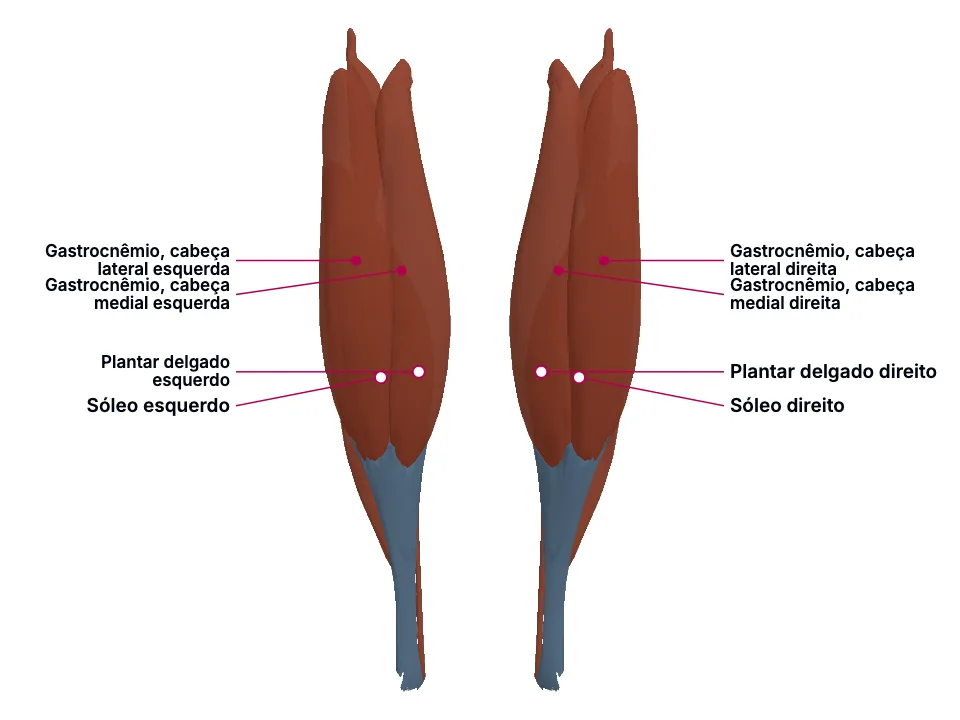
O tríceps sural (gastrocnêmio, biarticular - cruza joelho e tornozelo -, e sóleo, monoarticular - só tornozelo, com papel postural sustentado) converge no tendão calcâneo (de Aquiles), cuja ruptura súbita é detectada pelo teste de Thompson (compressão da panturrilha sem flexão plantar resultante) e precisa ser diferenciada da lesão do PRÓPRIO gastrocnêmio ('tennis leg', Thompson negativo) e de trombose venosa profunda, que pode mimetizar clinicamente qualquer um dos dois quadros. A imobilização prolongada retira a contribuição da bomba muscular da panturrilha ao retorno venoso - fator de risco real para TVP -, e o plantar delgado, ausente em cerca de 10% da população e clinicamente quase irrelevante quando presente, ainda assim serve de enxerto tendíneo cirúrgico em reparos do próprio tendão calcâneo.
Material educacional escrito com apoio de IA e conferido por revisão automatizada, sem revisão médica nomeada. Não substitui o livro-texto nem orientação clínica.
Essencial
O tríceps sural (gastrocnêmio e sóleo) converge num único tendão comum, o tendão calcâneo (de Aquiles): 'The gastrocnemius muscle is a biarticular muscle that originates on the posterior aspect of the femur along the medial and lateral condyles, forming both medial and lateral heads. Deep to it is the soleus muscle, which originates on the posterior surface of the fibula and medial border of the tibia.' Esse tendão é a via final que transmite a força de contração da panturrilha até o calcanhar.
Se essa via está íntegra, comprimir a panturrilha (sem qualquer contração voluntária do paciente) deve produzir flexão plantar passiva do pé - é o teste de Thompson: 'The examiner should perform the Thompson test to assess for Achilles tendon continuity in the setting of suspected rupture. The patient is positioned in the prone position with the ipsilateral knee flexed to about 90 degrees while the foot and ankle rest. By squeezing the calf, the examiner observes the presence and degree of plantarflexion at the foot and ankle. This should be compared to the contralateral side.' Quando o tendão está roto, essa transmissão se perde: 'In the Thompson test, squeezing the calf should normally elicit plantar flexion, but this motion may become diminished or absent in tendon rupture. Conversely, the presence of a plantar-flexion mechanism does not definitively exclude a partial tear or rupture.'
O tríceps sural tem 3 cabeças musculares, mas duas relações articulares diferentes: 'the triceps surae muscle group comprises 3 muscular heads; the soleus is monoarticular, and the plantaris and gastrocnemius are biarticular' O sóleo fica coberto pelo gastrocnêmio e cruza só o tornozelo: 'The soleus is monoarticular and is covered by the gastrocnemius'
Como o gastrocnêmio cruza joelho E tornozelo, a posição do joelho muda a tensão que ele recebe - o que o sóleo, só articulado no tornozelo, não sofre. É essa diferença que o teste de Silfverskiöld explora: 'The Silfverskiöld test helps determine whether equinus deformity is attributable to soleus or gastrocnemius contracture. Dorsiflexion of the ankle with the knee flexed at 90°, combined with limited dorsiflexion with the knee extended, indicates gastrocnemius shortening with preserved soleus function.'
As veias perfurantes da panturrilha regulam o fluxo sanguíneo durante a contração muscular - o que a fonte chama de 'calf pump': 'The perforating veins of the calf, which help regulate blood flow during muscle contraction (eg, the "calf pump"), include groups such as the Cockett (posterior tibial) perforators, and the Dodd and Hunterian groups.' A integridade dos músculos, válvulas e bombas venosas é o que permite o retorno do sangue contra a gravidade: 'The patency of blood veins, valves, and muscle pumps is necessary for the venous system to function properly.'
Quando essa bomba para de funcionar - por imobilidade, não por doença venosa primária -, o fluxo sanguíneo se reduz e o sangue estagna nas veias profundas da perna: 'Reduced blood flow: Immobility (bed rest, general anesthesia, operations, stroke, long flights)' A trombose venosa profunda (TVP) costuma se originar exatamente aí: 'DVT usually involves the lower limb venous system, with clot formation originating in a deep calf vein and propagating proximally.'
O plantar delgado é um músculo fino, presente em só parte da população: 'The group consists of 3 components: 2 superficial heads, the medial and lateral heads that form the gastrocnemius muscle, and a deeper muscle, the soleus. The plantaris muscle is present in a small percentage of individuals.' Especificamente: 'The plantaris is absent in approximately 10% of the population. The muscle's tendon courses lateral to, but rarely fuses with, the calcaneal tendon. The plantaris muscle–tendon unit typically remains intact in cases of calcaneal tendon rupture.'
'Tennis leg' NÃO é o nome de uma lesão do plantar delgado - é a lesão do PRÓPRIO gastrocnêmio (cabeça medial): 'Gastrocnemius strain occurs most commonly in middle-aged or older patients. Gastrocnemius strain may also occur in younger athletes and is sometimes referred to as tennis leg.' - num mecanismo de extensão máxima do joelho com dorsiflexão do tornozelo: 'The term is derived from the posture to serve tennis, which involves maximal knee extension and ankle dorsiflexion.' - 'This mechanism often happens in tennis players and is termed “tennis leg” in which rapid change of direction, such as when returning a shot, can result in a medial gastrocnemius injury.' O plantar delgado entra nesse quadro só como diagnóstico diferencial raro, não como a causa típica: 'Findings from a study of 141 patients with clinically diagnosed tennis leg showed that 67% had a partial tear of the medial gastrocnemius, 1.4% had an associated plantaris tendon rupture, and 21% had an intermuscular fluid collection without a medial gastrocnemius muscle tear. Ten percent had deep vein thrombosis without visible gastrocnemius pathology.'
Na clínica
O teste tem acurácia alta - 'particularly when a positive Thompson test is 96% to 100% sensitive and 93% to 100% specific' -, mas ainda assim a ruptura é frequentemente perdida na prática clínica: 'over 20% of Achilles tendon ruptures are misdiagnosed' O quadro típico é dor súbita com um estalo audível: 'Achilles tendon rupture is the most common tendon rupture in the lower extremity. The injury most commonly occurs in adults in their third to fifth decade of life. Acute ruptures often present with sudden onset of pain associated with a "snapping" or audible "pop" heard at the injury site. Patients may describe a sensation similar to being kicked in the lower leg.', tipicamente no perfil descrito como: 'Achilles tendon injuries predominantly occur in individuals who engage in sporadic physical activity, often referred to as "weekend warrior" athletes, and they most frequently occur during soccer, racket games, or basketball.'
Na prática, isso significa que alongar o gastrocnêmio exige o joelho ESTENDIDO (para tensioná-lo também na origem femoral), enquanto alongar o sóleo isoladamente exige o joelho FLETIDO (reduzindo a tensão no gastrocnêmio) - o mesmo princípio que separa encurtamento de um músculo do outro no exame físico, e que explica por que uma cãibra recorrente pode responder a técnicas de alongamento diferentes conforme o músculo envolvido.
O risco NÃO é hipérbole: imobilização por viagem prolongada, por exemplo, quantifica esse risco: 'Immobilization associated with prolonged travel, by air or ground, increases the risk of DVTs by 2 to 4 fold.' - e o manejo da 'calf muscle pump function' entra explicitamente no plano terapêutico de quem já tem insuficiência venosa: 'calf muscle pump function, and obesity-related risk'
Quando presente, o plantar delgado é clinicamente quase irrelevante por conta própria - mas seu tendão serve de enxerto cirúrgico para reforçar o reparo do tendão calcâneo roto: 'The plantaris tendon, gastroc-soleus aponeurosis, or the flexor hallucis tendon sometimes reinforce the repair.' A mesma dor súbita de panturrilha que sugere 'tennis leg' também está na lista de diagnóstico diferencial da ruptura do tendão calcâneo, ao lado da própria TVP: 'Deep venous thrombosis (DVT) Exertional compartment syndrome Fascial tears Gastrocnemius or soleus muscle strain or rupture Haglund deformity Plantaris tendon tear'
Abrir o aprofundamento
Aprofundamento
Dor súbita na panturrilha ou no tornozelo, muitas vezes com um estalo audível ('pop'), é a queixa comum a pelo menos três quadros distintos - e o exame físico, não só a queixa, é o que separa um do outro: 'Achilles tendon rupture is the most common tendon rupture in the lower extremity. The injury most commonly occurs in adults in their third to fifth decade of life. Acute ruptures often present with sudden onset of pain associated with a "snapping" or audible "pop" heard at the injury site. Patients may describe a sensation similar to being kicked in the lower leg.'
Ruptura do tendão calcâneo (de Aquiles) - teste de Thompson POSITIVO (ausência de flexão plantar à compressão da panturrilha): 'In the Thompson test, squeezing the calf should normally elicit plantar flexion, but this motion may become diminished or absent in tendon rupture. Conversely, the presence of a plantar-flexion mechanism does not definitively exclude a partial tear or rupture.' Acurácia alta do teste, mas diagnóstico ainda assim perdido em mais de 1 a cada 5 casos: 'particularly when a positive Thompson test is 96% to 100% sensitive and 93% to 100% specific' - 'over 20% of Achilles tendon ruptures are misdiagnosed'; Lesão do gastrocnêmio ('tennis leg', cabeça medial mais comumente) - teste de Thompson NEGATIVO, com flexão plantar preservada: 'A Thompson squeeze test (used to assess for Achilles tendon rupture) will be negative with normal plantar flexion upon squeezing the calf.' O próprio exame recomenda o teste de Thompson quando a palpação não basta para confirmar que o tendão está intacto: 'The Achilles tendon should be palpated to determine if it is intact. If the clinician is unable to ascertain this from palpation, the Thompson test can be done.' O gastrocnêmio é mais vulnerável por cruzar três articulações: 'The gastrocnemius muscle is vulnerable to injury because it crosses 3 joints: the knee, the ankle, and the subtalar joint.'; Trombose venosa profunda (TVP) - o teste de Thompson não se aplica (não há tendão nem músculo rompido), mas o quadro pode ser clinicamente indistinguível: num estudo de pacientes com 'tennis leg' diagnosticada clinicamente, 'Ten percent had deep vein thrombosis without visible gastrocnemius pathology' (dentro de 'Findings from a study of 141 patients with clinically diagnosed tennis leg showed that 67% had a partial tear of the medial gastrocnemius, 1.4% had an associated plantaris tendon rupture, and 21% had an intermuscular fluid collection without a medial gastrocnemius muscle tear. Ten percent had deep vein thrombosis without visible gastrocnemius pathology.'), e a TVP também consta na lista de diagnóstico diferencial da ruptura do tendão calcâneo: 'Deep venous thrombosis (DVT) Exertional compartment syndrome Fascial tears Gastrocnemius or soleus muscle strain or rupture Haglund deformity Plantaris tendon tear'
Teste-se antes de seguir
Um jogador de futebol sente dor aguda no calcanhar com um estalo audível durante um sprint. Ao exame, o examinador comprime a panturrilha do paciente (prono, joelho fletido a 90°) e NÃO observa flexão plantar do pé. O que esse achado indica, e por que a compressão da panturrilha deveria produzir esse movimento em condições normais?
A resposta fica na Avaliação, sem spoiler aqui.
Responder na AvaliaçãoFontes (9)
- Wong M, Jardaly AH, Kiel J. Anatomy, Bony Pelvis and Lower Limb: Achilles Tendon. [Updated 2023 Aug 8]. In: StatPearls [Internet]. Treasure Island (FL): StatPearls Publishing; 2026 Jan-.
The gastrocnemius muscle is a biarticular muscle that originates on the posterior aspect of the femur along the medial and lateral condyles, forming both medial and lateral heads. Deep to it is the soleus muscle, which originates on the posterior surface of the fibula and medial border of the tibia.
- Shamrock AG, Dreyer MA, Varacallo MA. Achilles Tendon Rupture. [Updated 2023 Aug 17]. In: StatPearls [Internet]. Treasure Island (FL): StatPearls Publishing; 2026 Jan-.
The examiner should perform the Thompson test to assess for Achilles tendon continuity in the setting of suspected rupture. The patient is positioned in the prone position with the ipsilateral knee flexed to about 90 degrees while the foot and ankle rest. By squeezing the calf, the examiner observes…
- Medina Pabón MA, Bergman R, Naqvi U. Achilles Tendinopathy. [Updated 2026 Jun 8]. In: StatPearls [Internet]. Treasure Island (FL): StatPearls Publishing; 2026 Jan-.
the triceps surae muscle group comprises 3 muscular heads; the soleus is monoarticular, and the plantaris and gastrocnemius are biarticular
- Bordoni B, Varacallo MA. Anatomy, Bony Pelvis and Lower Limb: Gastrocnemius Muscle. [Updated 2026 Apr 11]. In: StatPearls [Internet]. Treasure Island (FL): StatPearls Publishing; 2026 Jan-.
The soleus is monoarticular and is covered by the gastrocnemius
- Patel SK, Manea C, Surowiec SM. Venous Insufficiency. [Updated 2026 Jan 31]. In: StatPearls [Internet]. Treasure Island (FL): StatPearls Publishing; 2026 Jan-.
The patency of blood veins, valves, and muscle pumps is necessary for the venous system to function properly.
- Waheed SM, Kudaravalli P, Hotwagner DT. Deep Venous Thrombosis. [Updated 2023 Jan 19]. In: StatPearls [Internet]. Treasure Island (FL): StatPearls Publishing; 2026 Jan-.
Reduced blood flow: Immobility (bed rest, general anesthesia, operations, stroke, long flights)
- McLendon K, Goyal A, Attia M. Deep Venous Thrombosis Risk Factors. [Updated 2023 Mar 17]. In: StatPearls [Internet]. Treasure Island (FL): StatPearls Publishing; 2026 Jan-.
Immobilization associated with prolonged travel, by air or ground, increases the risk of DVTs by 2 to 4 fold.
- Hsu D, Chang KV. Gastrocnemius Strain. [Updated 2023 Aug 14]. In: StatPearls [Internet]. Treasure Island (FL): StatPearls Publishing; 2026 Jan-.
Gastrocnemius strain occurs most commonly in middle-aged or older patients. Gastrocnemius strain may also occur in younger athletes and is sometimes referred to as tennis leg.
- Coffey R, Khan YS. Gastrocnemius Rupture. [Updated 2023 Jul 24]. In: StatPearls [Internet]. Treasure Island (FL): StatPearls Publishing; 2026 Jan-.
This mechanism often happens in tennis players and is termed “tennis leg” in which rapid change of direction, such as when returning a shot, can result in a medial gastrocnemius injury.
Mais resumos de Anatomia
Depois de ler, use o que aprendeu
Atlas
Veja as estruturas do tema em 3D e navegue por camadas.
Caso clínico
Aplique o conteúdo numa decisão de plantão.
Exame
Interprete o resultado que fecha o raciocínio.
Avaliação
Responda as perguntas dos blocos e veja onde você está.
Tutor de IA
Tire a dúvida que o texto não resolveu.
Comece grátis: crie a conta e prove uma amostra do Atlas em 3D, do caso clínico, do exame, da avaliação e do tutor de IA. Sem cartão de crédito.
Começar grátis