Vasos do membro superior: pulsos, acesso venoso e fístula de diálise
Em 30 segundos
Os pulsos braquial (auscultado na fossa cubital, e checado como reserva quando o radial está fraco) e radial (palpado no punho) são a referência do exame vascular básico, e o teste de Allen verifica se a artéria ulnar sustenta a mão antes de mexer na radial.
Escopo e método deste resumo
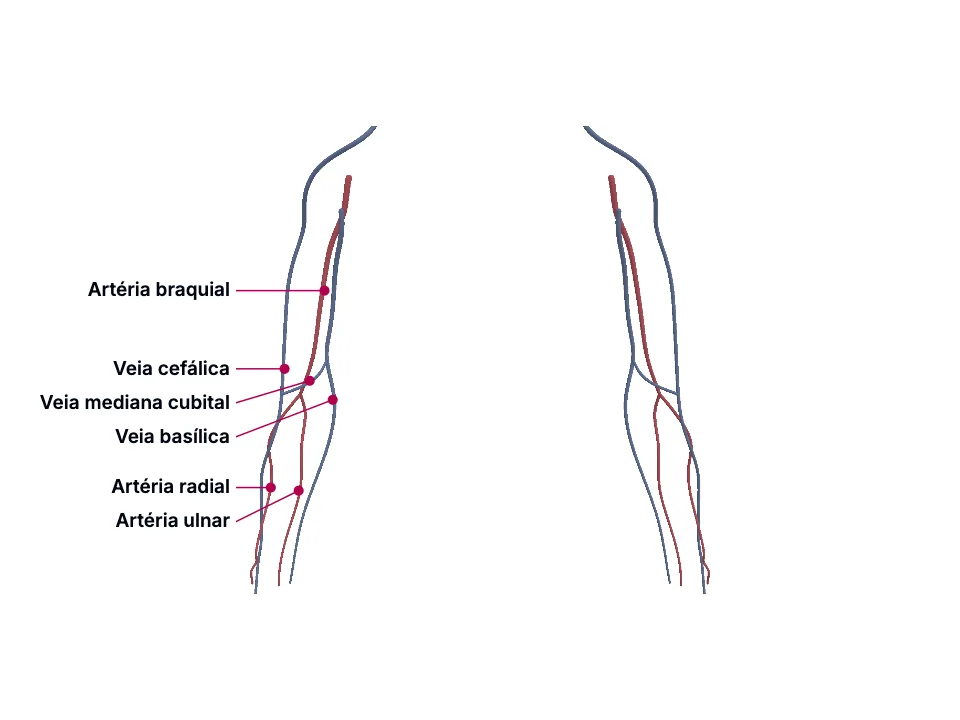
Os pulsos braquial (auscultado na fossa cubital, e checado como reserva quando o radial está fraco) e radial (palpado no punho) são a referência do exame vascular básico, e o teste de Allen verifica se a artéria ulnar sustenta a mão antes de mexer na radial. A fístula radiocefálica (Brescia-Cimino), entre artéria radial e veia cefálica no punho, é a primeira escolha de acesso para hemodiálise crônica. Na fossa cubital, a veia mediana cubital (paredes espessas, superficial à aponeurose bicipital) é o sítio mais comum de punção venosa, enquanto a basílica corre junto de artéria e nervo e pede cautela, mas é a via preferida de PICC pelo trajeto mais retilíneo até a cava.
Material educacional escrito com apoio de IA e conferido por revisão automatizada, sem revisão médica nomeada. Não substitui o livro-texto nem orientação clínica.
Essencial
A artéria braquial nasce como continuação direta da axilar: 'The brachial artery is the extension of the axillary artery starting at the lower margin of the teres major muscle and is the major artery of the upper extremity.' Ao chegar na fossa cubital, ela se bifurca: 'Once the brachial artery reaches the cubital fossa, it divides into its terminal branches: the radial and ulnar arteries of the forearm.' Um dos dois ramos, a radial, nasce medial ao tendão do bíceps e desce até o punho: 'The radial artery originates from the brachial artery at the cubital fossa, medial to the biceps tendon, and courses anterior to the radial neck'
É sobre a artéria braquial, na fossa cubital, que se ausculta a pressão arterial: 'Traditionally, the brachial artery is the primary vessel used when measuring blood pressure with a sphygmomanometer.' e 'When assessing manual blood pressure, a stethoscope is placed over the cubital fossa to auscultate the brachial artery for Korotkoff sounds.' Já a radial, mais distal e mais superficial no punho, é palpada diretamente: 'Palpating the radial artery proximal to the wrist crease and immediately lateral to the FCR tendon is a common method for assessing pulse intensity and rate.' - os dois pulsos, braquial (proximal, auscultado) e radial (distal, palpado), formam a referência básica do exame vascular periférico de membro superior.
A artéria ulnar é o maior dos dois ramos terminais da braquial, nascendo na fossa cubital: 'It arises from the brachial artery as its larger terminal branch at the level of the cubital fossa with the brachialis muscle at its deep surface.' Logo depois de nascer, ela passa profundamente ao nervo mediano antes de seguir pelo antebraço: 'It then passes deep to the median nerve and courses obliquely and medially (ulnarly) beneath the pronator teres, flexor carpi radialis, palmaris longus' - uma relação de proximidade que a própria fonte destaca: 'The close anatomic relationship of the ulnar artery to the median nerve proximally and the ulnar nerve more distally is worth noting.'
Radial e ulnar, juntas, perfundem a mão através de um arco: 'The hand is perfused by both the radial and ulnar arteries, which form a rich arterial plexus in the region. Compromised circulation in one artery may result in compensation by the other to ensure that the hand's blood supply is adequate.' É essa compensação mútua que o teste de Allen verifica antes de sacrificar uma das duas (por exemplo, antes de cateterizar a radial para gasometria).
No punho, a artéria radial é superficial e palpável ao longo de todo o antebraço distal - o mesmo trajeto que sustenta a palpação do pulso radial -, e a veia cefálica, que parte do lado lateral (radial), começando segundo a fonte na face anterolateral do punho, passa perto, no mesmo lado do antebraço. Cirurgicamente, esses são os dois vasos escolhidos para a fístula arteriovenosa mais distal: 'The cephalic and basilic veins are often used for the surgical creation of an AVF. The radial artery at the volar wrist and the brachial artery at the antecubital fossa and medial upper arm are typical anatomical locations for fistula creation.'
Essa anastomose tem nome próprio na técnica cirúrgica: 'The radiocephalic fistula is a distal forearm fistula created by anastomosing the cephalic vein to the radial artery.' e é reconhecida como a preferida: 'However, the radio-cephalic AVF is the preferred initial access for hemodialysis.' A sociedade de referência recomenda o motivo: 'The Society of Vascular Surgery recommends placing access as distal in the upper extremity as possible to preserve future central access while giving preference to the non-dominant arm.'
O teto da fossa cubital é formado, da pele para dentro, por três camadas: 'the roof (from superficial to deep) forms from the skin, fascia, and the bicipital aponeurosis' A veia mediana cubital corre DENTRO desse teto, não na fossa propriamente: 'While not in the cubital fossa itself, found within the roof is the median cubital vein - forming a communication between the cephalic and basilic superficial veins of the arm.' conectando as duas veias superficiais do braço: 'The two primary superficial veins of the arm have an essential communication in the roof of the cubital fossa - the median cubital vein.' Ela é muito superficial, o que a torna facilmente acessível: 'When considering venepuncture, one of the most commonly used sites is the median cubital vein. It lies very superficially within the roof of the cubital fossa, making it an easily accessible vein.'
A camada mais profunda desse mesmo teto - a aponeurose bicipital - fica entre a mediana cubital e o conteúdo da fossa (a artéria braquial e o nervo mediano, profundos a ela), e historicamente ganhou um apelido por causa desse papel: 'Historically, when (venous) blood-letting was practiced, the bicipital aponeurosis (the ceiling of the cubital fossa) was known as the "grace of God" tendon because it protected the more important contents of the fossa (ie, the brachial artery and the median nerve).' A relação anatômica é descrita por uma camada nomeada, não por uma direção vaga como 'profundo' ou 'medial'; a fonte de flebotomia, porém, justifica a escolha da mediana cubital pela parede espessa (ver abaixo), e não atribui a segurança da punção à aponeurose.
A veia basílica nasce na rede venosa dorsal da mão e segue pela face medial do braço: 'Originating from the dorsal venous network of the hand, the basilic vein travels on the medial aspect of the upper extremity.' até se juntar à veia braquial e formar a axilar: 'The basilic vein joins with the brachial vein to form the axillary vein (at the lower border of teres major), with the cephalic vein then draining into the axillary vein within the axilla region.'
Pelo calibre e pela proximidade com a pele, ela é a via preferida para PICC: 'The right basilic vein’s size and proximity to the skin make it the attempted vein of choice for PICC placement.' e pelo trajeto até a veia cava: 'A right basilic venotomy location provides the least tortuous path toward the superior vena cava. This vein is thought to have the least number of valves and provides a more optimal access angle.'
Na clínica
Quando o pulso radial está fraco, a referência mais proximal entra em jogo: 'Brachial artery palpation may be necessary if the ulnar artery is not palpable and the radial pulse is weak.' - ou seja, a mesma artéria braquial usada para medir a pressão arterial também serve de pulso de reserva quando o exame distal é inconclusivo.
O teste de Allen segue um protocolo específico: 'The Allen test, first described by Edgar Van Nuys Allen in 1929, evaluates arterial blood flow to the hand. To perform the test, the patient elevates both arms above the head for 30 seconds to drain blood from the hands. The patient then clenches both fists tightly while the examiner occludes the radial arteries in both hands. Afterward, the patient rapidly opens both hands, and the examiner compares the color of the palms. Normal color should replace the initial pallor as the ulnar arteries restore perfusion.' - se a cor normal não retorna com a ulnar ocluída e só a radial aberta (ou vice-versa), a circulação colateral daquela mão não é suficiente para arriscar a artéria testada.
Na prática, isso monta uma ordem de preferência clara ao planejar o acesso de hemodiálise crônica: 'Dialysis fistula creation of choice is radiocephalic fistula, brachiocephalic fistula, transposed brachiobasilic fistula, and then loop arteriovenous graft.' - a radiocefálica (Brescia-Cimino) vem primeiro exatamente por ser a mais distal, preservando os vasos mais proximais (antebraço alto, braço) para um segundo acesso, se o primeiro falhar.
Na prática, isso faz da mediana cubital o sítio mais comum de coleta de sangue: 'The common location for a blood draw is in the medial cubital fossa. In this area, the medial cubital vein is superficial and covers the bicipital aponeurosis in the cubital fossa.' e 'The median cubital vein is the most common choice because of the thick walls that can tolerate the negative pressures when drawing blood.' Em contraste, a veia basílica (mais medial ao longo do braço) exige cautela extra: 'It is extremely critical to distinguish the median cubital vein from the basilic vein, medial along the arm. Extra precaution when drawing blood from the basilic vein is necessary because it runs with the artery and nerve.'
Quando a basílica não está acessível ou está ocluída, a fonte prevê a veia braquial: 'If the basilic vein is not accessible or occluded, an attempt at accessing the right brachial vein may be attempted.' - com um custo: 'There is a higher risk of accidental arterial puncture with this venous access location with the brachial artery nearby.' A escolha, portanto, pesa o trajeto até a cava de um lado e a vizinhança arterial do outro.
Abrir o aprofundamento
Aprofundamento
As duas veias superficiais principais do membro superior partem cada uma de um lado, na região da mão e do punho: a cefálica pelo lado lateral (radial) e a basílica pelo medial (ulnar). Da cefálica, a fonte descreve: 'The cephalic vein commences on the anterolateral surface of the wrist, and the basilic vein begins on the anteromedial aspect of the wrist.' Só para a basílica a fonte cita a rede venosa dorsal da mão: 'Originating from the dorsal venous network of the hand, the basilic vein travels on the medial aspect of the upper extremity.'
Veia cefálica - parte do lado lateral (do polegar), na região do punho, e sobe pelo lado lateral do antebraço e do braço, drenando diretamente na veia axilar, na axila.; Veia basílica - parte do lado medial (do dedo mínimo), na rede venosa dorsal da mão, e sobe pelo lado medial do braço, juntando-se à veia braquial (uma veia profunda, não derivada dessa mesma rede superficial do punho) para formar a axilar: 'The basilic vein joins with the brachial vein to form the axillary vein (at the lower border of teres major), with the cephalic vein then draining into the axillary vein within the axilla region.' - um ponto de chegada diferente do da cefálica, e um dos motivos pelos quais a basílica oferece um trajeto mais retilíneo até a veia cava para fins de PICC.; Veia mediana cubital - não é uma terceira veia com origem própria: é a comunicação que une cefálica e basílica dentro do teto da fossa cubital, a meio do caminho entre os dois pontos de origem na mão e no punho: 'The two primary superficial veins of the arm have an essential communication in the roof of the cubital fossa - the median cubital vein.'; Contraste que NÃO é co-derivado: a artéria braquial (e o nervo mediano que a acompanha) atravessa essa MESMA fossa cubital, mas não nasce da rede venosa superficial do punho - vem de uma linhagem arterial totalmente diferente (a continuação da axilar). As duas famílias de estruturas convivem no mesmo compartimento anatômico sem serem a mesma coisa em pontos diferentes do trajeto: a artéria e o nervo são conteúdo da fossa, profundos a uma camada à parte, a aponeurose bicipital, que os separa da veia superficial e historicamente ganhou o apelido de tendão "grace of God" por essa função: 'Historically, when (venous) blood-letting was practiced, the bicipital aponeurosis (the ceiling of the cubital fossa) was known as the "grace of God" tendon because it protected the more important contents of the fossa (ie, the brachial artery and the median nerve).'
Teste-se antes de seguir
Um paciente tem pulso radial fraco à direita, mas o restante do exame parece normal. Que outro pulso o examinador deve checar em seguida, no mesmo membro, e que outro uso clínico esse mesmo vaso já tem no exame físico de rotina?
A resposta fica na Avaliação, sem spoiler aqui.
Responder na AvaliaçãoFontes (9)
- Epperson TN, Varacallo MA. Anatomy, Shoulder and Upper Limb, Brachial Artery. [Updated 2023 Jul 24]. In: StatPearls [Internet]. Treasure Island (FL): StatPearls Publishing; 2026 Jan-.
The brachial artery is the extension of the axillary artery starting at the lower margin of the teres major muscle and is the major artery of the upper extremity.
- Sheen JR, Khan YS. Anatomy, Shoulder and Upper Limb, Cubital Fossa. [Updated 2023 Jul 24]. In: StatPearls [Internet]. Treasure Island (FL): StatPearls Publishing; 2026 Jan-.
When assessing manual blood pressure, a stethoscope is placed over the cubital fossa to auscultate the brachial artery for Korotkoff sounds.
- Marchese RM, Launico MV, Geiger Z. Anatomy, Shoulder and Upper Limb, Forearm Radial Artery. [Updated 2025 Mar 3]. In: StatPearls [Internet]. Treasure Island (FL): StatPearls Publishing; 2026 Jan-.
The radial artery originates from the brachial artery at the cubital fossa, medial to the biceps tendon, and courses anterior to the radial neck
- Marques E, Bordoni B. Anatomy, Shoulder and Upper Limb, Ulnar Artery. [Updated 2023 Jul 24]. In: StatPearls [Internet]. Treasure Island (FL): StatPearls Publishing; 2026 Jan-.
It arises from the brachial artery as its larger terminal branch at the level of the cubital fossa with the brachialis muscle at its deep surface.
- Jayroe H, Foley K. Arteriovenous Fistula. [Updated 2022 Nov 21]. In: StatPearls [Internet]. Treasure Island (FL): StatPearls Publishing; 2026 Jan-.
The cephalic and basilic veins are often used for the surgical creation of an AVF. The radial artery at the volar wrist and the brachial artery at the antecubital fossa and medial upper arm are typical anatomical locations for fistula creation.
- Marsh AM, Genova R, Buicko Lopez JL. Dialysis Fistula. [Updated 2023 May 23]. In: StatPearls [Internet]. Treasure Island (FL): StatPearls Publishing; 2026 Jan-.
The radiocephalic fistula is a distal forearm fistula created by anastomosing the cephalic vein to the radial artery.
- Bains KNS, Lappin SL. Anatomy, Shoulder and Upper Limb, Elbow Cubital Fossa. [Updated 2023 Jul 17]. In: StatPearls [Internet]. Treasure Island (FL): StatPearls Publishing; 2026 Jan-.
Historically, when (venous) blood-letting was practiced, the bicipital aponeurosis (the ceiling of the cubital fossa) was known as the "grace of God" tendon because it protected the more important contents of the fossa (ie, the brachial artery and the median nerve).
- Srikanth KK, Lotfollahzadeh S. Phlebotomy. [Updated 2023 Aug 28]. In: StatPearls [Internet]. Treasure Island (FL): StatPearls Publishing; 2026 Jan-.
The common location for a blood draw is in the medial cubital fossa. In this area, the medial cubital vein is superficial and covers the bicipital aponeurosis in the cubital fossa.
- Agarwal A, Montanarella MJ, Moon B. Peripherally Inserted Central Catheter (PICC) Line Placement. [Updated 2024 Jan 10]. In: StatPearls [Internet]. Treasure Island (FL): StatPearls Publishing; 2026 Jan-.
Originating from the dorsal venous network of the hand, the basilic vein travels on the medial aspect of the upper extremity.
Onde isso cai na prática
1 caso clínico do acervo exige este tema. Veja onde ele decide a conduta.
Planejamento pré-dialítico na doença renal crônica progressiva
Nefrologia
Abrir o caso grátis
Mais resumos de Anatomia
Depois de ler, use o que aprendeu
Atlas
Veja as estruturas do tema em 3D e navegue por camadas.
Caso clínico
Aplique o conteúdo numa decisão de plantão.
Exame
Interprete o resultado que fecha o raciocínio.
Avaliação
Responda as perguntas dos blocos e veja onde você está.
Tutor de IA
Tire a dúvida que o texto não resolveu.
Comece grátis: crie a conta e prove uma amostra do Atlas em 3D, do caso clínico, do exame, da avaliação e do tutor de IA. Sem cartão de crédito.
Começar grátis